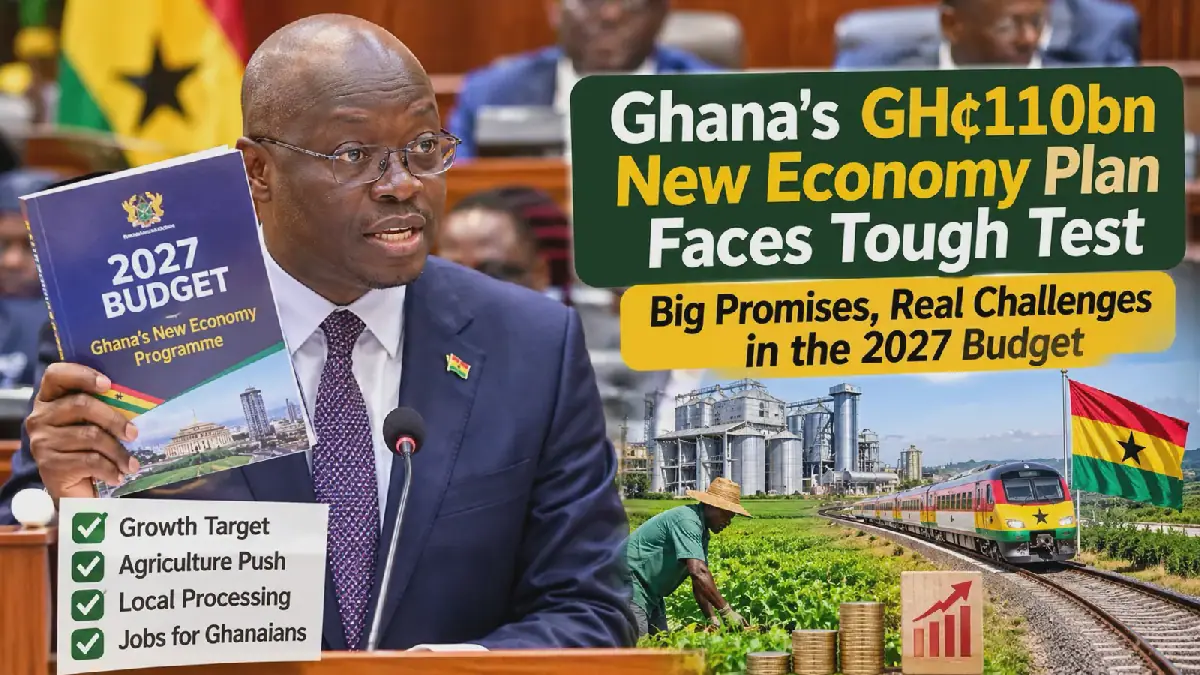
Ghana's 2027 Budget presents an ambitious attempt to move the country from economic stabilisation towards industrial expansion, domestic production and employment creation. The budget, presented by Finance Minister Dr Cassiel Ato Forson on November 12, outlines a US$10 billion investment programme, equivalent to approximately GH¢110 billion, which will run from 2027 to 2030. This New Economy Programme aims to finance commercial agriculture, energy infrastructure, critical minerals processing, pharmaceuticals, textiles, technology and other productive sectors.
The Government describes the initiative as a transition from stabilisation to prosperity, arguing that improved macroeconomic conditions have created the fiscal space necessary to invest in production, expand exports and generate employment. However, a closer examination of the figures, fiscal projections and policy commitments reveals a significant gap between the Government's transformation ambitions and the economic realities that will determine whether they can be achieved.
Ghana's economic circumstances have improved considerably since the crisis that forced the country to seek assistance from the International Monetary Fund in 2022. On July 27, 2026, the IMF Executive Board completed the sixth and final review of Ghana's 39-month Extended Credit Facility arrangement, bringing total disbursements under the US$3 billion programme to approximately US$3 billion. Ghana subsequently transitioned into a three-year Policy Coordination Instrument, which provides continued IMF monitoring and policy guidance without additional programme financing.
Inflation, which reached 54.1 per cent in December 2022, declined substantially, touching 3.2 per cent in March 2026 before edging upwards to 5.5 per cent in October. Economic growth also strengthened, with the economy expanding by 6.2 per cent during the first half of 2026, according to the Ministry of Finance. These are meaningful improvements. Lower inflation offers households some relief from the rapid increases in the prices of goods and services, while declining interest rates can gradually reduce the cost of borrowing for businesses and individuals.
The Bank of Ghana's reduction of its monetary policy rate from 21.5 per cent in September 2025 to 14 per cent in September 2026 also demonstrates the extent of the monetary easing made possible by improved economic conditions. However, declining inflation must not be confused with falling prices. When inflation decreases, prices generally continue rising, albeit at a slower rate. Consequently, the reduction in inflation does not automatically restore the purchasing power households lost during the period of exceptionally high price increases.
The proposed financing arrangement for the New Economy Programme involves reducing the primary surplus target from 1.5 per cent of GDP to 0.5 per cent, thereby creating additional room for investment, alongside an anticipated 0.5 per cent of GDP in additional revenue mobilisation. This is a significant policy shift that deserves greater public scrutiny. A primary surplus represents the excess of government revenue over expenditures, excluding interest payments.
The central question is whether Ghana possesses the financial resources, institutional capacity and industrial foundations to deliver the promises contained in the budget without undermining the very stability that has taken considerable effort to restore. The country's economic recovery remains vulnerable to external payments, import demand, commodity price fluctuations and the country's ability to sustain foreign exchange inflows. The budget itself now targets a recovery towards at least six months of import cover over the medium term.
Key points
- The programme's feasibility remains uncertain, particularly when examined against Ghana's production capacity, infrastructure constraints, financing arrangements and continuing fiscal vulnerabilities.