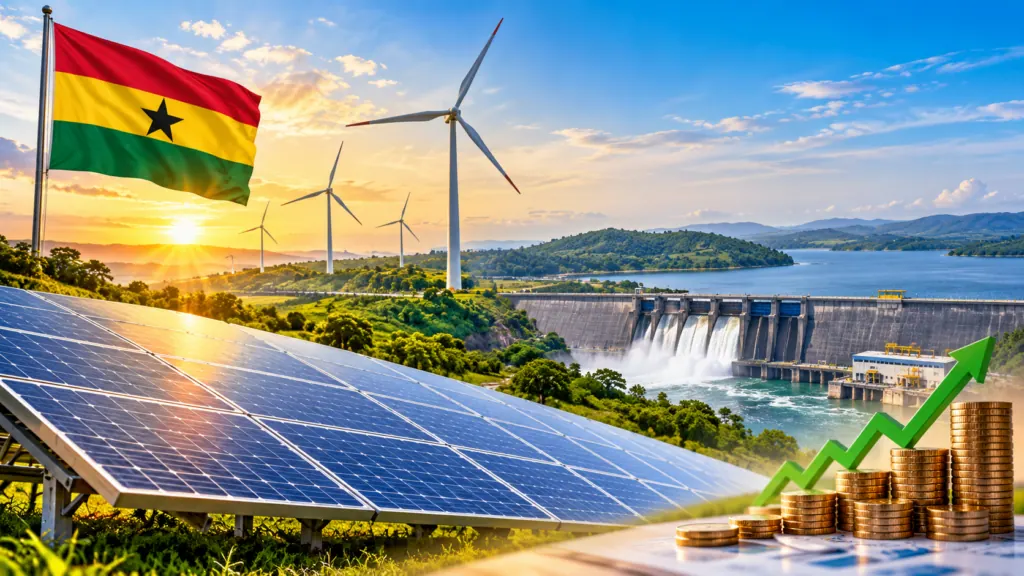
Ghana's ambition to transition to cleaner energy is no longer a question of whether it should happen, but how to finance it without burdening future generations. The Ministry of Energy and Green Transition estimates that Ghana will need more than $500 billion to achieve net-zero by 2070. This puts finance at the center of its long-term energy strategy. However, concern is growing about the quality and cost of that finance. The debate is shifting from mobilizing money for renewables to whether financing terms will expand access, create jobs, and build local industry without worsening debt.
The issue of financing the energy transition was discussed at a National Policy Dialogue on "Transitioning to a Just and Sustainable Renewable Energy Future" in Accra, organized by ActionAid Ghana. Government, civil society, and energy experts offered differing views on navigating the challenge. For Mr. John Nkaw, Country Director of ActionAid Ghana, a "just" transition must go beyond environmental gains. It must answer who participates in decision-making, who benefits, and who bears the cost. Workers, women, youth, and affected communities must shape the process, he said, while clean energy should improve access, affordability, and livelihoods.
ActionAid's 2026 report, "Debt Fuels the Climate Crisis: How the Finance Flows," found that the world's most climate-vulnerable countries spend far more on debt servicing than on climate action. Its analysis of 54 vulnerable countries showed $304.8 billion spent on debt servicing in 2026, against $12.3 billion on climate action – almost 25 times more. Debt servicing consumed about 65% of their national revenues – nearly four times spending on education, seven times health spending, and six times social protection. For Ghana, the finding is a warning, not a direct measure of its transition financing.
Mr. Seth Mahu, Director, Renewable Energy and Green Transition at the Ministry, admits that the $500 billion requirement is huge, but argues that the transition is not just a burden. It offers opportunities for energy security, affordability, industrial growth, and jobs if well implemented, he said. Renewables are targeted to account for 10% of installed capacity by 2030, 26% by 2040, 27% between 2050 and 2060, and 20% by 2070 as nuclear and thermal expand. The 2070 target translates to about 21,000 megawatts.
As of mid-2026, Ghana had 342.5MW of installed renewable capacity – utility-scale, rooftop, and stand-alone – about 6% of the generation mix, according to Mr. Mahu. Among current initiatives is a Solar Street Lighting Programme targeting 125,000 units. Procurement has started for 30,000 units covering about 1,000km of roads, expected to save 8.28 million kWh annually. Full rollout should save over 34 gigawatt hours. Government is also using renewables to close access gaps. Eight mini-grids have been commissioned, connecting over 15,000 people, while 35 more under construction will connect over 70,000 in island and lakeside communities.
For Dr. Charles Gyamfi Ofori, Policy Lead for Climate Change and Energy Transition at the Africa Centre for Energy Policy (ACEP), the challenge is not just installing renewables. Ghana must treat transition as an economy-wide development agenda, not a Ministry of Energy task alone, he said. It is financial, trade, industrial, gender, and social development. That means integrating it into everyday decisions – for instance, designing schools, kitchens, and markets so waste becomes feedstock for waste-to-energy, and using segregation to create value chains.
The Ministry estimates that 335,000 jobs could be created by the end of the decade if Master Plan targets are met. Bioenergy could create over 300,000 jobs across nurseries, plantations, processing, and transport. If renewable investments cut energy costs, boost productivity, build industry, and create jobs, they can strengthen the base for servicing obligations. Success will go beyond megawatts. Ghana has improved electricity access for lighting from 43.8% in 2000 to 86.3% in 2021, but the gap persists: 95.2% urban against 72.6% rural.
Key points
- Ghana needs over $500 billion to achieve net-zero by 2070.
- The country's transition to cleaner energy must be financed without burdening future generations.
- A "just" transition must go beyond environmental gains and answer who participates in decision-making, who benefits, and who bears the cost.