Ghana has a history of changing its development plans with each new government, raising concerns about the continuity and effectiveness of its national strategies. The country's development planning has been marked by a series of frameworks, including Vision 2020, which was introduced to guide the country's development for 25 years. However, the plan was not fully implemented, and subsequent governments have introduced new frameworks, often with different priorities and emphases. This cycle of change has led to concerns about the ability of Ghana's governments to commit to long-term plans and achieve sustainable development.
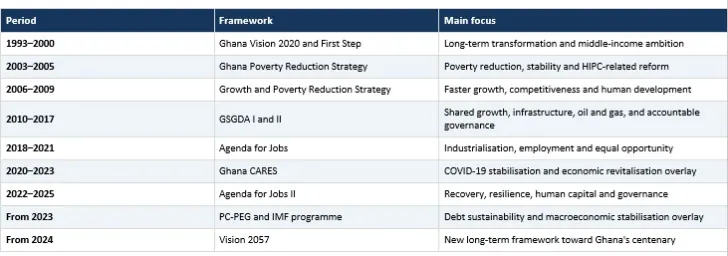
Since the Fourth Republic began in 1993, Ghana has adopted several development frameworks, including poverty-reduction strategies, shared-growth agendas, and jobs programmes. The Ghana Poverty Reduction Strategy, introduced in 2003, was followed by the Growth and Poverty Reduction Strategy, which shifted the focus from poverty reduction to accelerated growth and private-sector competitiveness. The country has also implemented the Shared Growth and Development Agenda (SGDDA) and the Agenda for Jobs, which have guided the country's development efforts in recent years.
The changes in development plans have not always been a result of a lack of vision or strategy, but rather a response to changing circumstances, such as the COVID-19 pandemic and fiscal and debt distress. The Ghana CARES Obaatan Pa programme, introduced in 2020, was a response to the pandemic, while the Post-COVID-19 Programme for Economic Growth and the IMF-supported recovery programme were introduced to address the country's economic challenges. However, these changes have also led to concerns about the continuity and coherence of Ghana's development plans.
The constant changes in development plans have come at a cost, with some projects being abandoned or renamed, and public money being spent on initiatives that are later discontinued. This has led to confusion and a lack of accountability, with citizens and parliamentarians often left wondering which promises still stand and who should be held accountable for failures. The changes have also drained the public service, with officials and contractors often having to redirect staff and resources in response to new priorities.
The issue of development planning is closely tied to the country's constitutional debate, with calls for rules that protect a shared national direction while allowing elected governments to choose their own policies and priorities. The National Development Planning Commission (NDPC) has introduced Vision 2057, a long-term framework that seeks to anchor medium-term plans in enduring priorities such as human capital, science and technology, and infrastructure. However, the success of this framework will depend on the ability of Ghana's governments to commit to long-term plans and achieve sustainable development.
The people of Ghana have a critical role to play in holding governments accountable for their development plans and ensuring that the country's development priorities are aligned with the needs and aspirations of its citizens. The basic democratic principle is that citizens own the state, and governments act on their behalf. However, in practice, this principle is often not reflected in the way that development plans are designed and implemented. A citizen-owned national plan would set out the outcomes that should endure, such as good schools, reliable healthcare, and productive jobs.
To address the challenges of development planning, Ghana's Constitution should protect the process of planning and ensure that the country's development priorities are aligned with the needs and aspirations of its citizens. The Constitution should not list specific projects or spending figures, but rather ensure that the process of planning is transparent, accountable, and inclusive. This would involve the NDPC having enough independence and information to assess progress and report it in a way that is understandable to the public. A government that changes an important national goal should give reasons, disclose the financial consequences, and face parliamentary scrutiny.