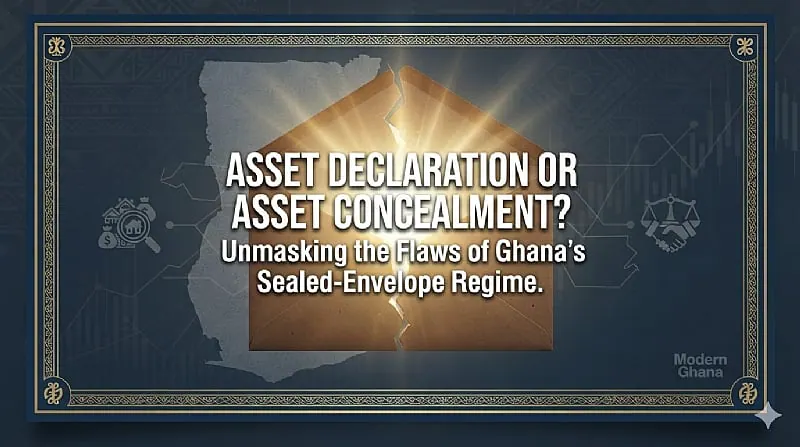
Ghana's anti-corruption efforts have been hindered by a flawed asset declaration regime, which has been criticized for being ineffective in preventing corruption. Despite being a key mechanism to fight corruption, the regime has been described as a "state-sanctioned protocol for hiding ill-gotten wealth rather than exposing it." The regime requires public officers to declare their assets before taking office, every four years, and upon leaving, but the existing system is structurally designed to fail.
One of the major flaws in the regime is the lack of verification. Appointees hand their declarations to the Auditor-General in a sealed envelope, which state authorities are legally forbidden from opening or verifying unless the official is already facing a formal corruption lawsuit or an active investigation. This makes the entire regime a passive repository rather than an active shield against public theft. Furthermore, failing to file does not carry strong criminal penalties or automatically trigger a prosecution.
The case of Dennis Miracles Aboagye, the former Executive Secretary of the Inter-Ministerial Coordinating Committee on Decentralisation, highlights the deep flaws in the verification system. Aboagye was arrested and investigated by the Economic and Organised Crime Office (EOCO) over alleged financial and procurement-related irregularities involving roughly GH¢55 million. However, because his asset declaration envelope remained legally locked and unverified prior to the crisis, state investigators had to manually track down his properties via lifestyle audits and inter-agency mapping after a petition was filed.
In contrast, President John Dramani Mahama's administration took a different approach to asset declaration. Mahama broke tradition by publicly submitting his completed asset declaration forms to the Auditor-General, demanding transparency across the political landscape. He also issued a strict directive ordering all government appointees to declare their assets by March 31, 2025, and instituted a consequence structure for defaulters, including automatic dismissal and a fine of three months' salary.
The presidency's efforts led to near-total compliance, demonstrating that executive political will can enforce accountability even within a flawed legal framework. However, Civil Society Organisations (CSOs) like the Ghana Anti-Corruption Coalition (GACC) have championed the passage of the Conduct of Public Officers (CoPO) Bill to establish permanent transparency. The bill introduces concrete punishments, including steep fines and prison sentences, for failing to submit forms.
The legislative battle centers on ensuring that public accountability strictly overrides absolute privacy. CSOs are actively campaigning to ensure the final bill remains uncompromised, warning against clauses that punish the breach of declaration confidentiality more harshly than the actual concealment of wealth. Ghana can draw lessons from established international frameworks, such as Kenya's Public Officer Ethics Act, which mandates that all public officers declare their income and assets every two years.
The international community has shown that asset verification can effectively deter illicit wealth accumulation. Ukraine's e-Declaration system, for example, provides a 100% digital, open-access online platform for asset declaration. Ghana can learn from these examples and work towards establishing a more effective asset declaration regime that promotes transparency and accountability.
Key points
- The Conduct of Public Officers Bill aims to introduce concrete punishments for failing to submit asset declarations.
- Ghana's asset declaration regime has been criticized for lacking verification and weak penalties for non-compliance.
- International frameworks, such as Kenya's Public Officer Ethics Act, can serve as a model for Ghana's asset declaration regime.