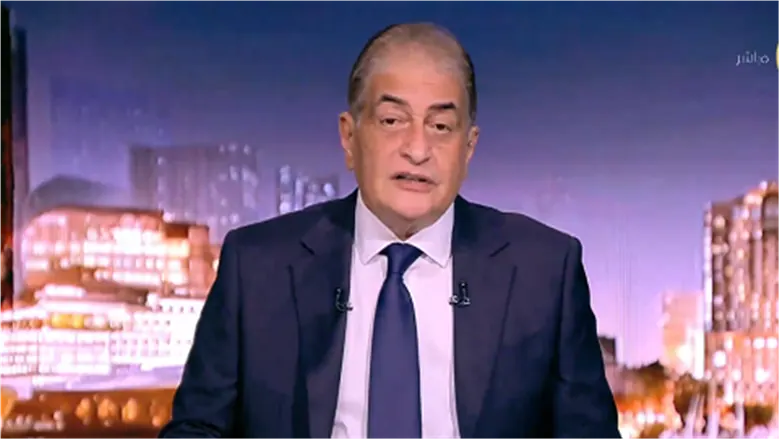
Egyptian media personality Osama Kamal has stated that responding to Israeli Prime Minister Benjamin Netanyahu's speech at the United Nations General Assembly requires presenting an alternative narrative based on facts and documents. Kamal made these comments during his program "Masaa DMC" on DMC TV. He emphasized that Netanyahu's speech primarily targeted an Israeli audience.
Kamal discussed Netanyahu's claims about the Iranian nuclear program, stating that the Israeli Prime Minister announced its destruction, while the International Atomic Energy Agency (IAEA) reported it could not verify the status of certain nuclear facilities and materials in Iran. Kamal highlighted the difference between eliminating a nuclear program and merely understanding its current state.
The Egyptian media figure also addressed Netanyahu's comments on the Golan Heights, pointing out that invoking historical narratives does not grant sovereignty over the territory. He stressed that the Golan remains Syrian land. Kamal also questioned Netanyahu's attempt to rename the West Bank using historical names, citing documents about the city of Shechem, which was once under Egyptian influence.
Kamal refuted Netanyahu's claims that there were no Israelis in Gaza before the October 7 attack, arguing that control over borders, economy, land, and movement constitutes a form of dominance that does not require a permanent military presence. He also countered Netanyahu's downplaying of settler violence, citing UN data that documented over 1,600 settler attacks during the specified period, resulting in Palestinian casualties and property damage.
Furthermore, Kamal discussed Netanyahu's remarks on warnings to civilians, asserting that such warnings do not make civilians legitimate targets. He referenced international reports and judicial decisions related to the Gaza war, including those from a UN investigative committee and the International Criminal Court.
Kamal emphasized that increasing political rhetoric does not negate the importance of facts and investigations. He called for an evidence-based response to Netanyahu's speech, which often relied on historical narratives and assertions disputed by various international bodies.
The debate over Netanyahu's UN speech continues, with many in the international community scrutinizing his claims and countering with their own evidence and interpretations. Kamal's comments reflect a broader discussion in Egypt and beyond about how to address Israeli policies and narratives.
Key points
- Osama Kamal calls for an evidence-based narrative to counter Netanyahu's UN speech.
- Kamal disputes Netanyahu's claims on the Iranian nuclear program and the Golan Heights.
- The Egyptian media figure emphasizes the need for factual responses to Israeli assertions.