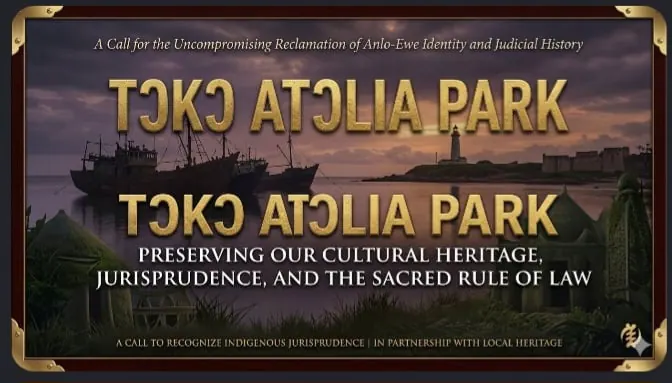
In a move to reclaim and preserve Ghana's historical assets, a proposal has been made to designate Tɔkɔ Atɔlia Park, formerly known as the "Fifth Landing Stage" in Anloga. This initiative seeks to create a dynamic environment where experiential domestic tourism and rigorous historical education intersect. The project, part of a broader strategy to activate the Anlo Heritage Corridor, aims to drive growth and promote Ghana's cultural heritage. According to Atitso Akpalu, the proposal is an intentional structural alignment with the principles of critical cultural preservation.
The historical significance of Tɔkɔ Atɔlia lies in its role as the institutional center of communal accountability for the pre-colonial Anlo state. The site served as an Indigenous Supreme Court, where individuals found guilty of severe infractions were punished. A philosophy of communal preservation underpinned the traditional sentence of ritualistic live burial, designed to maintain societal equilibrium rather than perpetuate arbitrary violence. Today, the site stands as a peaceful, defunct execution ground, representing a physical thesis on pre-colonial African societies' approach to civic order and ethical discipline.
The proposed park will provide a tangible, empirical resource for students to study indigenous West African governance and social control, thereby decolonizing the historical narrative. By integrating field studies at the park into basic and secondary social studies curricula, local schools can move historical education out of abstract textbooks and into living, open-air classrooms. Additionally, the physical presence of a dedicated park will serve as an anchor for local historians and elders to pass down precise, unadulterated oral accounts to younger generations.
The tourism aspect of the proposal seeks to expand the Volta tourism circuit by providing a distinct historical asset that complements existing regional destinations. A developed park would directly anchor a high-potential historical corridor, including nearby Fort Prinzenstein in Keta and the iconic Cape St. Paul Lighthouse in Woe. This will offer tourists a multifaceted regional itinerary spanning colonial, maritime, and indigenous Ewe histories. The Atorkor Slave Market Corridor, located just 28 kilometers from Keta, will also be integrated into the proposed park.
The proposed park will also foster experiential domestic travel, tapping into the growing segment of Ghanaian travelers seeking historically significant domestic destinations. Furthermore, the local assembly can capture high-value cultural tourism revenue by offering guided, academic tours that connect festival rituals directly to physical landmarks, particularly during the annual Hogbetsotso Festival. This festival attracts thousands of international and diasporic tourists to Anloga each year.
To match the gravitas of this heritage corridor, the infrastructure will feature evocative, structural markers that facilitate healing, education, and remembrance. The proposed memorial architecture includes the Frieze of Remembrance, the Pillar of Dual Justice, and an Eco-Acoustic Amphitheater. These installations will depict the pre-colonial judicial evolution, local folklore, and the stark realities of the coastal transit routes, while symbolizing the intersection of indigenous customary jurisprudence and the human quest for liberty.
The realization of this cultural project requires systemic, institutional intervention from state leadership, particularly the Minister for Tourism, Culture, and Creative Arts, and the Ministry of Tourism, Arts and Culture (MoTCCA). The Ministry is urged to use its executive mandate and work through its frontline agencies to bring this project to fruition. The proposed Tɔkɔ Atɔlia Park represents a significant step towards preserving Ghana's cultural heritage and promoting national growth through tourism and education.
Key points
- The proposed Tɔkɔ Atɔlia Park aims to promote heritage tourism and decolonial education in Ghana's Volta Region.
- The park will provide a tangible resource for students to study indigenous West African governance and social control.
- The project requires institutional intervention from state leadership to come to fruition.