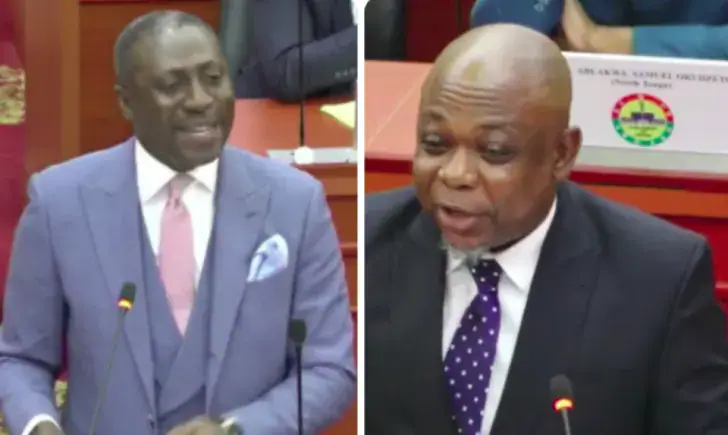
The debate on Ghana's 2027 Budget Statement in Parliament has turned into a clash between the Majority and Minority leaders over the government's reported economic gains and the reality on the ground. Minority Leader Alexander Afenyo-Markin questioned the impact of the government's economic policies on ordinary Ghanaians, arguing that official statistics do not reflect the financial realities facing households and businesses. He described a divide between the "paper economy" presented by the government and the "pocket economy" experienced by citizens.
Afenyo-Markin argued that improvements in economic indicators would have little meaning to citizens if they did not translate into lower living costs and better financial conditions. He stated that the "market woman cannot eat paper" and that citizens cannot pay school fees or feed their children with government statements. The Minority Leader questioned whether the reported decline in prices and improvements in economic indicators were making a meaningful difference to households and small businesses.
In response, Majority Leader James Agalga defended the 2027 Budget as a "people's budget," saying it delivers on the government's promises to reduce inflation, borrowing, and excessive public spending without introducing new taxes. Agalga cited a drop in inflation to 5.5 per cent in October and a public debt stock of GH¢759.3 billion, equivalent to 47.5 per cent of GDP, as evidence of the government's success. He argued that the budget challenges the notion that economic progress must come at the expense of increased public debt.
The debate took a different turn when Agalga accused the previous New Patriotic Party (NPP) administration of creating the conditions that allowed cocaine smuggling into Ghana. He alleged that the NPP removed the Narcotics Control Commission (NACOC) from the country's ports of entry to facilitate the trade. This sparked a dispute, with Agalga rejecting Minority accusations that the current government was responsible for recent cocaine shipments.
The parliamentary exchanges come amid investigations into major seizures, including the interception of 3.9 tonnes of cocaine hidden in a plastic waste container from Ghana at the French port of Dunkirk, and the seizure of 46.7 kilogrammes of the substance in Beirut, Lebanon. The seizures have raised concerns about cocaine smuggling into Ghana and the government's efforts to curb the trade.
Agalga warned the Minority against raising the issue of cocaine smuggling, stating that their "record stinks." The Majority Leader's comments were in response to accusations that the current government was responsible for the recent cocaine shipments. The debate on the 2027 Budget is expected to conclude with a vote in Parliament.
The disagreement between the Majority and Minority leaders reflects the ongoing challenges facing Ghana's economy and the government's efforts to address them. The 2027 Budget Statement has been a subject of debate, with both sides presenting their arguments on the government's economic policies and their impact on citizens. The outcome of the debate and the vote on the budget remain to be seen.
Key points
- The Majority and Minority leaders in Ghana's parliament have clashed over the government's economic policies and allegations of cocaine smuggling.
- The 2027 Budget Statement has been defended by the Majority Leader as a "people's budget" that delivers on the government's promises to reduce inflation and borrowing.
- The debate has highlighted the ongoing challenges facing Ghana's economy, including the impact of official statistics on ordinary citizens and the government's efforts to curb cocaine smuggling.
Reporting sources
- 2027 Budget debate: Majority and Minority clash over cocaine... · Daily Graphic