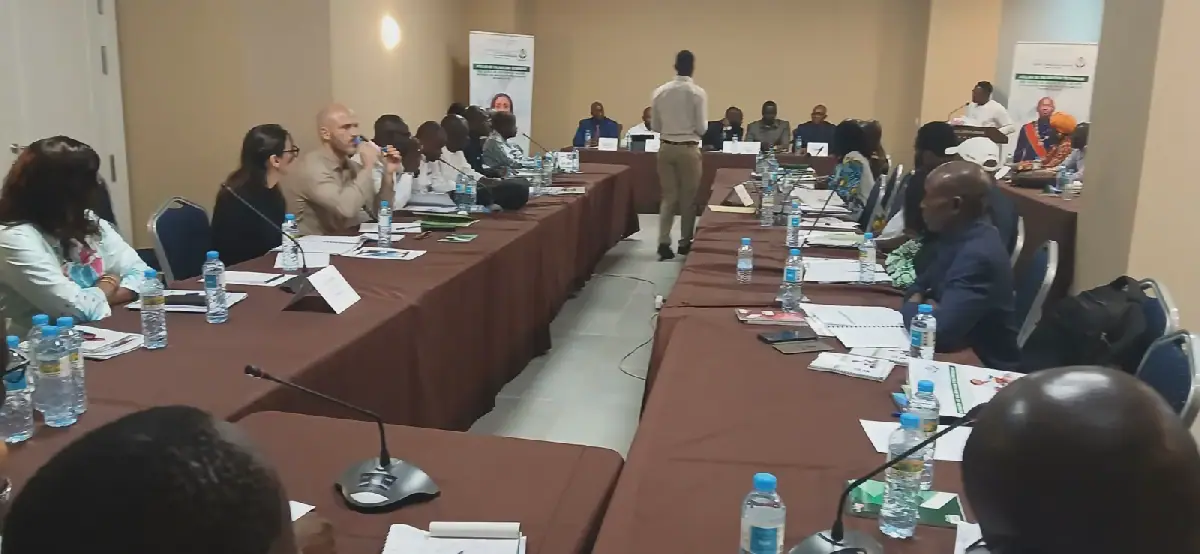
The Ministry of Employment, Labor, and Social Protection in Guinea is holding a technical validation workshop for tools to manage the country's list of 92 compensable occupational diseases. This development is part of efforts to enhance social protection for workers in Guinea. The workshop, which took place on November 26, 2026, aims to make the official list of occupational diseases operational. The list was established by presidential decree on November 5, 2026.
The validation workshop was attended by various stakeholders, including institutional actors, health professionals, representatives from social security organizations, and experts in the sector. The goal is to transition from a regulatory framework to a concrete system that can identify, report, document, track, and compensate occupational diseases. Dr. Alhouseine Yansané, Director General of Occupational Safety and Health, emphasized the importance of this initiative for modernizing the national occupational health system.
Dr. Yansané highlighted that unrecognized occupational diseases often escape prevention mechanisms and do not contribute to informing public decisions. He stressed that the challenge now is to make occupational diseases visible and provide relevant stakeholders with practical instruments adapted to ground realities. The aim is to build a system capable of tracking diseases, sectors, workers, exposure conditions, and consequences.
Professor Assane Bah, President of the Guinean National Order of Physicians, praised the work done by the National Occupational Health Service teams. He recalled the key steps that led to the adoption of the national list, including the launch of elaboration works on May 13, 2024, with support from the International Labor Bureau. Bah noted that recognizing compensable occupational diseases is a significant advancement for Guinea's social protection system.
However, Bah also emphasized that having a list is not enough without mechanisms for its effective application. He highlighted that occupational medicine is not only preventive but also a medicine of responsibility and social justice. It contributes to preserving the country's human capital, maintaining workers' health, and promoting safer professional environments.
Mohamed Lamine Traoré, Deputy Director General of the National Social Security Fund (CNSS), described the workshop as a crucial step in implementing the reform. He recalled that the decree signed on November 5, 2026, officially establishes the national list of 92 compensable occupational diseases. Traoré stressed that this progress provides a common reference framework for identifying occupational diseases and facilitating workers' access to their rights.
The tools to be validated concern various stages of handling dossiers, from the job description and medical certificate to disease declaration, medical advice, dossier instruction, decision notification, and possible appeals. Traoré also highlighted the modernization efforts of the CNSS, including the e-CNSS platform, which allows employers to declare work accidents online.
Key points
- The Guinean government aims to enhance social protection for workers by validating technical tools for managing 92 compensable occupational diseases.
- The list of occupational diseases was established by presidential decree on November 5, 2026.
- The validation workshop seeks to make the list operational and provide practical instruments for identifying, reporting, and compensating occupational diseases.