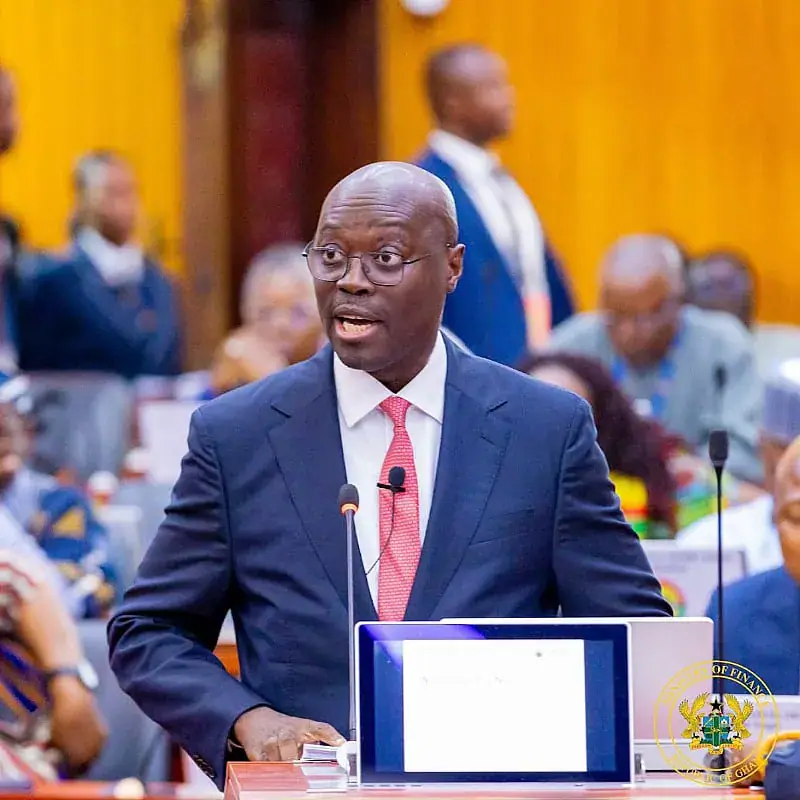
Ghana's Finance Minister, Ato Forson, has presented the 2027 budget in Parliament, outlining the government's economic policy and budget statement for the upcoming year. The budget is built on the authority of President John Dramani Mahama and in accordance with the 1992 Constitution and the Public Financial Management Act, 2016. Forson emphasized that Ghana has made significant gains, emerging from a severe economic crisis, with stability and confidence restored.
The 2027 budget aims to consolidate the gains made in 2025, when Ghana began to restore order, credibility, and economic stability. Within one year, inflation fell from 23.8% to 5.4%, the primary balance improved from a deficit of 4.1% to a surplus of 2.5% of GDP, public debt declined to 44.7% of GDP, and Gross International Reserves rose to 5.7 months of import cover. These gains have given households greater certainty and allowed businesses to plan for the future.
However, Forson acknowledged that Ghana's economic growth has been volatile, with boom-and-bust cycles that have hindered the country's ability to build secure lives for its citizens. Between 1990 and 2025, real GDP growth averaged 5.2%, but this conceals the volatility within that growth. Commodity upswings have lifted revenue and national confidence, but when prices drop or fiscal discipline weakens, the cedi comes under pressure, inflation rises, interest rates climb, and investment declines.
The minister highlighted that Ghana's dependence on raw commodities has deepened its vulnerability, with gold, cocoa, and oil dominating exports, while extractive industries accounted for about 16% of GDP growth over the last decade. This has resulted in an economy that can post growth figures while leaving too many citizens outside the promise of that growth. Unemployment stood at about 12.8% in 2025, despite more than three decades of economic expansion.
Forson emphasized that the best measure of an economy is an improvement in the quality of life, and the 2027 budget aims to address the challenges faced by Ghanaians, including youth searching for jobs, farmers seeking reliable markets, market women whose capital was eroded by inflation, pensioners whose life savings were wiped out, and entrepreneurs lacking affordable long-term finance.
The minister stressed that Ghana has a moral obligation to use its fiscal space wisely, earned through the sacrifices of the Ghanaian people, taxes, and government discipline. The government aims to direct fiscal space with sufficient purpose, avoiding the mistakes of the past, where scarce resources were spread thinly across competing demands, and projects multiplied without rigorous appraisal.
The 2027 budget seeks to create a more resilient economy, with a focus on production, jobs, rising incomes, and opportunities for all Ghanaians. The government aims to honour the sacrifices of the Ghanaian people by ensuring that the hardship they endured does not become their children's inheritance. The budget statement and economic policy will be captured in the Hansard Department for reference.
Key points
- The 2027 budget aims to sustain economic stability and growth in Ghana.
- Ghana's economy has made significant gains, emerging from a severe crisis, with stability and confidence restored.
- The budget seeks to address the challenges faced by Ghanaians, including unemployment, inflation, and lack of access to finance.