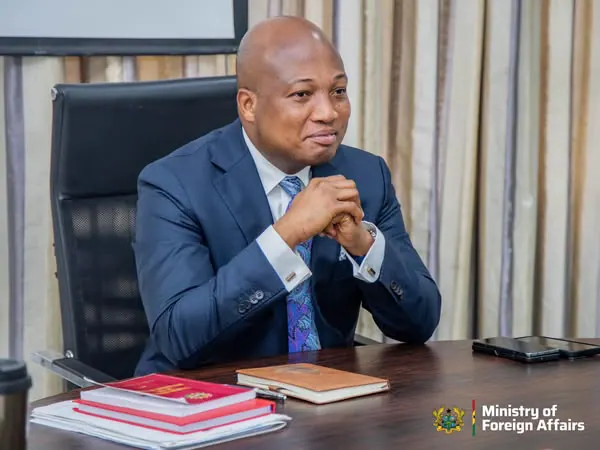
Ghana's Foreign Affairs Minister, Samuel Okudzeto Ablakwa, has announced that the United States has formally communicated its willingness to work with Ghana towards a fairer and more just global order. This development comes despite the US voting against a UN resolution declaring the transatlantic slave trade the gravest crime against humanity. The announcement was made at the Next Steps High-Level Side Event on Reparatory Justice, held on the sidelines of the 81st United Nations General Assembly in New York.
Minister Ablakwa welcomed the US engagement, saying it would encourage other countries holding African cultural heritage to participate in the restitution process. He emphasized that Ghana's reparatory justice campaign was not intended to create division, but rather to establish a new relationship based on trust, reconciliation, and cooperation. The Minister also highlighted recent developments in the restitution of African cultural heritage, including the Netherlands' cataloguing of 2,000 Ghanaian artefacts for return.
Ablakwa cited a new US law on the restitution of Jewish cultural property as an example of the principle that should be extended to African heritage taken during periods of colonialism and conflict. He argued that the principle underlying the legislation—that looted cultural property should be returned regardless of where it is held or how long it has remained there—should also apply to African artefacts. The Minister commended the US for this new law signed by President Donald Trump.
The Foreign Affairs Minister called on European countries that maintain legal restrictions on the deaccessioning of national collections to review and repeal such laws. He pointed to France and the United States as examples, noting that significant portions of Africa's cultural heritage remained outside the continent. Minister Ablakwa stressed that restitution was not merely an abstract historical debate, but a pressing issue that required action.
Minister Ablakwa noted that Africa's history, represented in sacred wood carvings, royal bronzes, Kente and manuscripts, remained preserved in collections thousands of miles away from the communities that created them. He emphasized that the issue of restitution was crucial in this generation, with many African artefacts held in museums and private collections in Europe and the United States.
The Minister highlighted other recent developments in the restitution of African cultural heritage, including Germany's engagement with the Kpando traditional area and France's legislative initiatives on restitution. He also cited the return of the Djidji Ayokwe talking drum to Côte d'Ivoire as evidence of progress. Minister Ablakwa called for such efforts to be transformed into a permanent and coordinated global system for restitution.
Minister Ablakwa's statement was met with optimism, as Ghana's reparatory justice campaign gained momentum. He acknowledged that reparatory justice was a difficult and emotionally charged subject, but emphasized that the current generation had a responsibility to establish a new relationship based on trust, reconciliation, and cooperation. The US engagement is seen as a significant step towards achieving this goal.
Key points
- The US has formally communicated its willingness to work with Ghana on reparations for the transatlantic slave trade despite voting against a UN resolution.
- Ghana's Foreign Affairs Minister, Samuel Okudzeto Ablakwa, welcomes the US engagement as a positive step towards a fairer and more just global order.
- The Minister calls on European countries to review and repeal laws restricting the deaccessioning of national collections to facilitate the return of African cultural heritage.