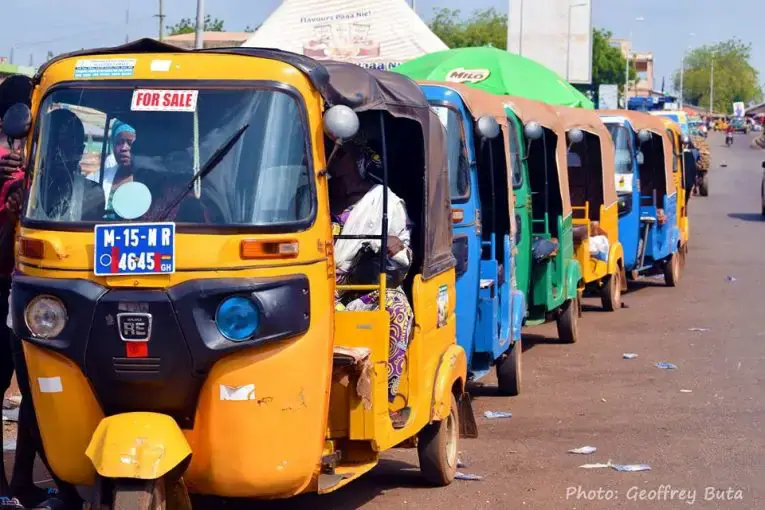
Commercial tricycle operators, popularly known as pragyia riders, and their passengers in Ghana could face arrest, fines or imprisonment if they fail to comply with road safety regulations requiring the use of protective helmets and reflective clothing. The requirements, provided for under Ghana’s Road Traffic Regulations, 2012 (L.I. 2180), apply to both riders and passengers.
Ghana's Road Traffic Regulations, 2012 (L.I. 2180) set the rules for how vehicles are registered, who can drive, how vehicles should be maintained, and how road users must behave to ensure safety on Ghana's roads. It covers licences, roadworthiness, speed limits, traffic signs, seat belts, vehicle standards, and penalties for traffic offences.
Chief Inspector Frimpong Ayeh of the Motor Traffic and Transport Department (MTTD) said the regulations leave no room for passengers to be exempted from the safety requirements. He explained that the perception that tricycles offer a level of protection similar to cars does not change the obligation of riders and passengers to use the prescribed safety gear.
Under Regulation 109 of L.I. 2180, riders and passengers are expected to wear appropriate helmets that fit properly, with their chin straps securely fastened. They must also wear reflective clothing. The regulation further requires riders to ensure that passengers below the age of 18 comply with these safety measures.
Anyone convicted of violating the provision faces a fine of between 25 and 50 penalty units, imprisonment for one to three months, or both. There is also a separate provision under Regulation 176(2) which specifically addresses commercial passengers who travel without protective helmets.
In a related development, in 2023 the transport sub-committee of the Kumasi Metropolitan Assembly (KMA) put forth a recommendation to impose restrictions on Aboboya and Pragyia (tricycles) within the key areas of Kumasi's central business district. According to the Public Relations Officer of the KMA, Afia Konadu, at the time, the new measure was aimed at alleviating congestion in the central business district.
The move by KMA comes after the Greater Accra Regional Coordinating Council, led by the then Regional Minister, Henry Quartey, announced a ban on tricycles on Highways within the national capital. The ban was aimed at ensuring compliance and enforcement of the Road Traffic Regulations, 2012 (LI 2180), which came into effect on November 1, 2021.
Key points
- Commercial tricycle operators and passengers in Ghana face penalties for failing to wear helmets and reflective clothing as required by road safety regulations.
- The regulations apply to both riders and passengers, with specific requirements for helmets and reflective clothing.
- There are distinctions between regulations for commercial tricycles and motorcycles, with implications for operator responsibilities.