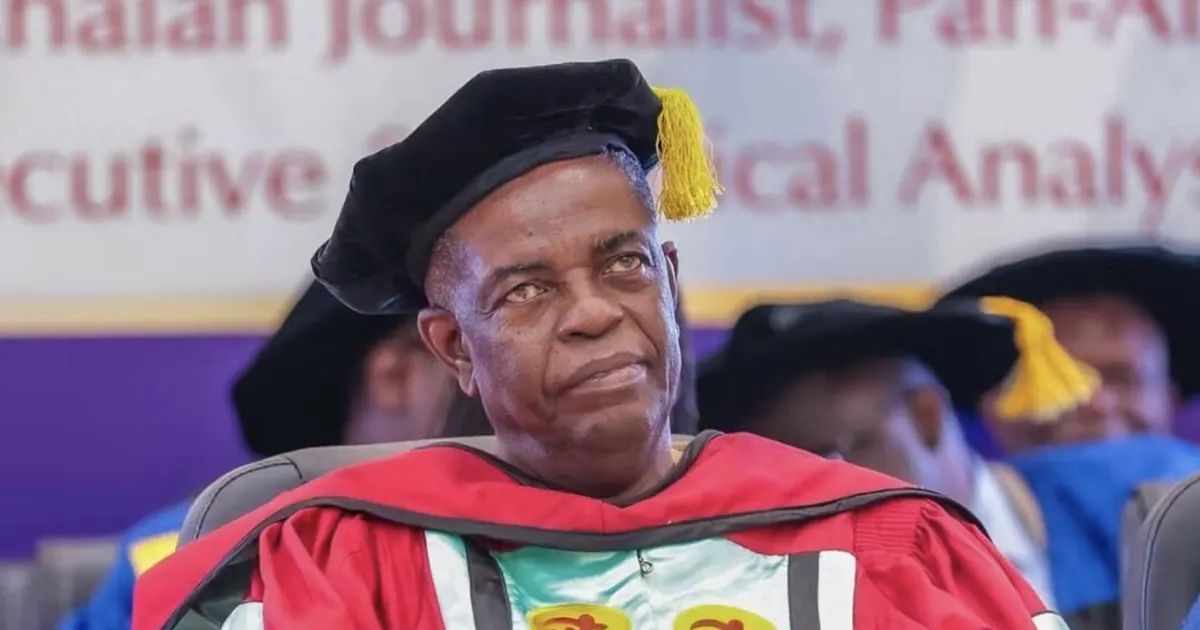
Veteran journalist Kwesi Pratt Jnr has urged Ghana to learn from Dr Kwame Nkrumah's Seven-Year Development Plan to address the country's persistent economic challenges. The plan, which covered 1963 to 1970, had a long-term vision and invested in infrastructure, education, energy, industry, and social services, creating national assets that continue to serve generations. Mr Pratt made the call in Cape Coast at the 15th Kwame Nkrumah Memorial Lecture series organised by the University of Cape Coast (UCC).
The lecture series was on the theme: “Kwame Nkrumah yesterday, today and tomorrow: Perspectives on constitutionalism, development and Pan-Africanism.” Mr Pratt noted that Nkrumah's plan was built around six key areas, including state-led industrialisation, economic diversification, agricultural modernisation, infrastructure development, human capacity, and an African economic purpose. He argued that the policy represented one of the most comprehensive attempts by post-independence governments to transform Ghana's colonial economic structure and lay the foundation for economic independence.
Mr Pratt observed that Nkrumah recognised that political independence without transforming the colonial economic structure would remain incomplete. He noted that Ghana's economy was largely dependent on the export of cocoa, gold, timber, and other raw materials, and the importation of manufactured goods, a pattern that persists today. To address this, Nkrumah embarked on state-led industrialisation, creating State enterprises in manufacturing, agriculture, transportation, hospitality, and other sectors.
Mr Pratt cited the Akosombo Dam and Volta River Project, Tema Harbour, roads, electricity, Tema Township, and industrial estates as major investments intended to provide the foundation for productive economic activity. Nkrumah also invested in education and human capacity by expanding primary, secondary, technical, and university education to produce the skilled workforce needed for national development. This investment in human beings was crucial for operating and sustaining a modern society.
The Seven-Year Plan also linked Ghana's development to the wider economic advancement of Africa, seeking to reduce colonial dependency and build a productive continental economy. Mr Pratt acknowledged that the development plan faced some serious challenges, including the collapse of world cocoa prices, increased external debt, shortages, inflation, and weaknesses in the administrative and financial capacity of the state.
Mr Pratt debunked the assertion that Nkrumah destroyed the economy when he took over as President, an accusation that ostensibly contributed to his overthrow. He stressed that Nkrumah did not destroy a diversified, industrial, and self-sufficient economy but inherited a dependent commodity-export economy and attempted to transform it. That attempt produced major national assets that continue to benefit Ghana.
Mr Pratt concluded that the correct lesson from Nkrumah's experience is not to abandon national planning or industrialisation but to combine them with stronger management, accountability, technological competence, realistic sequencing, and disciplined evaluation. He emphasised that Nkrumah's development strategy was not confined to factories and dams but also invested in the human beings who would operate and sustain a modern society.
Key points
- Kwesi Pratt Jnr has called on Ghana to draw lessons from Dr Kwame Nkrumah's Seven-Year Development Plan.
- The plan was built around six key areas, including state-led industrialisation and economic diversification.
- Mr Pratt debunked the assertion that Nkrumah destroyed the economy when he took over as President.