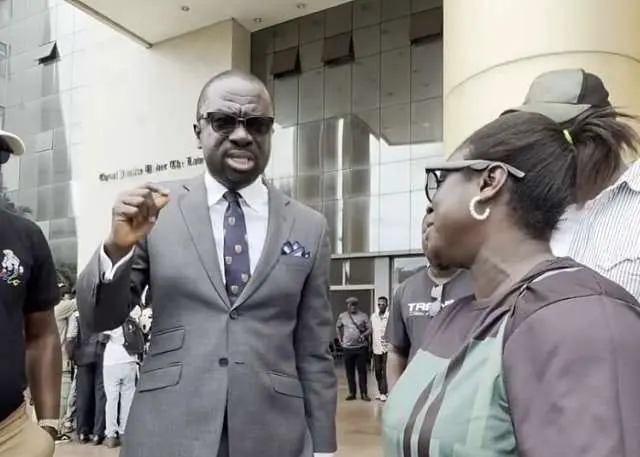
On Wednesday, a dramatic scene unfolded in Ghana as the Economic and Organized Crime Office (EOCO) attempted to arrest Manhyia South MP Nana Agyei Baffour Awuah. According to EOCO, the MP failed to honour two invitations issued in February 2026. However, Baffour Awuah disputes this account, stating that the invitations were related to the senior partner of his former law firm. The incident has raised questions about the circumstances surrounding the attempted arrest and the MP's subsequent actions.
Baffour Awuah claimed that he feared kidnapping because the woman who approached him did not produce identification or an arrest warrant and insisted that he use EOCO's vehicle. He drove away and appeared at Parliament, which is currently on recess. EOCO respects parliamentary privileges but maintains that being an MP does not terminate an investigation or place anyone beyond the law. The incident has sparked debate about the balance between parliamentary privilege and accountability.
The video of the encounter shows the operation looking painfully under-resourced, with EOCO sending one lady to the middle of a potentially confrontational situation. Critics argue that this approach was flawed and put the officer in an exposed position. If EOCO had decided that an arrest was necessary, it should have gone with adequate reinforcement and a properly coordinated team capable of securing the situation.
The incident has also raised questions about the MP's public advocacy and potential conflicts of interest. Some politicians become remarkably vocal defenders of ordinary citizens when the spotlight turns toward them. One cannot help but wonder if every act of public advocacy is completely unrelated to the personal circumstances of the person doing the advocating.
Article 117 protects parliamentary privilege in specific circumstances connected with proceedings of Parliament; it is not a blanket declaration that an MP cannot be investigated or arrested. Baffour Awuah is urged to prove EOCO wrong if it is indeed wrong, and challenge its officers if they acted unlawfully.
The attempted arrest has sparked reactions from various quarters, with some politicians and experts weighing in on the issue. The Minority Leader, Kyei-Mensah-Bonsu, has called for EOCO to be reined in over the attempted arrest, describing it as unjustified and dangerous.
The incident highlights the need for clarity on the balance between parliamentary privilege and accountability. As Ghana continues to navigate this complex issue, it is essential to ensure that accountability does not become compromised by claims of immunity or privilege.
Key points
- EOCO's under-resourced operation has raised questions about its approach to arrests and investigations.
- The incident has sparked debate about the balance between parliamentary privilege and accountability.
- Baffour Awuah's public advocacy has raised questions about potential conflicts of interest.