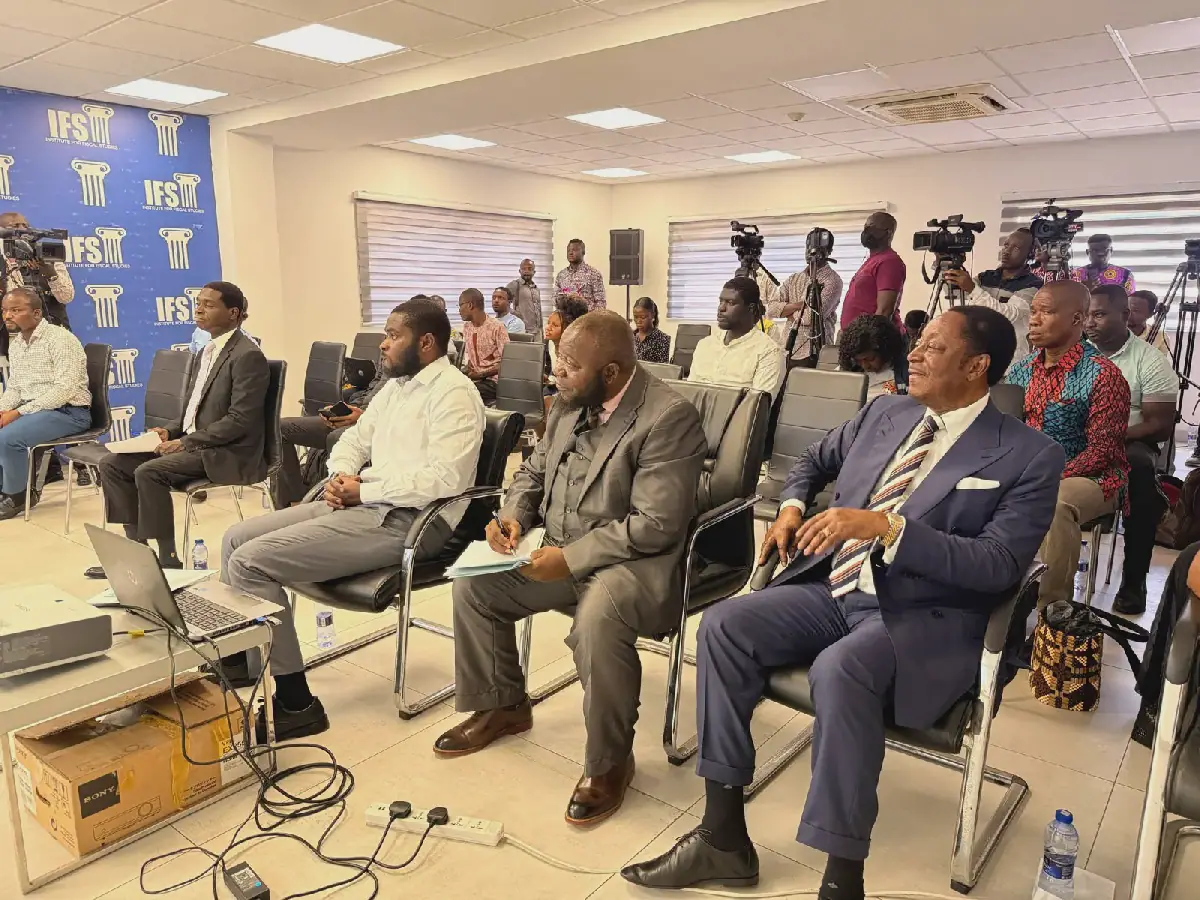
The Executive Director of the Institute for Fiscal Studies (IFS), Dr Said Boakye, has warned that Ghana is losing billions of dollars in potential government revenue due to weak revenue mobilisation, corruption, revenue leakages, and excessive tax exemptions. Speaking at the institute's office in Accra on Thursday, November 5, 2026, Dr Boakye presented the institute's October 2026 policy brief, which highlighted the country's low government revenue mobilisation.
According to Dr Boakye, Ghana's revenue collection remains significantly below the levels recorded by several other Sub-Saharan African countries. Ghana's total revenue and grants accounted for 15.7 per cent of its Gross Domestic Product (GDP), placing the country 18th among 25 Sub-Saharan African countries assessed. This figure is below the regional average of 20.1 per cent, while Namibia, Seychelles, and Botswana recorded 31.3 per cent, 30 per cent, and 29.5 per cent, respectively.
Dr Boakye explained that Ghana's poor revenue performance means the government is collecting far less money than it could generate to finance development. If Ghana's revenue-to-GDP ratio had matched the Sub-Saharan African average of 20.1 per cent, the country could have raised GH¢288.26 billion in total revenue and grants in 2025, which is GH¢63.38 billion more than the GH¢224.88 billion actually collected during the year.
The country's weak revenue mobilisation has serious consequences for national development, including inadequate infrastructure, increased government borrowing, rising debt servicing costs, and low public sector salaries. Ghana's relatively low per capita GDP of US$2,419 in 2024, compared with US$7,650 in Botswana, US$6,267 in South Africa, and US$4,502 in Namibia, is a testament to this.
Dr Boakye identified three major factors responsible for Ghana's weak revenue mobilisation: low revenue generation from the extractive sector, revenue leakages, and excessive tax exemptions granted to businesses to attract investment. On revenue from mining, he said Ghana earned relatively little from its mineral resources despite having a large mining industry, with government revenue from mining representing an average of only 15 per cent of the sector's value added between 2019 and 2023.
To address the problem, Dr Boakye recommended that the government take a more active role in the extractive sector by investing directly in mining activities or partnering with private investors, as practised in Botswana. He proposed the introduction of production-sharing agreements as an alternative to the current concession system to enable the country to earn more from its natural resources and called for a stronger fight against corruption, particularly within institutions responsible for collecting tax and non-tax revenue.
Dr Boakye further recommended a reward and punishment system to encourage revenue officials who perform their duties properly while ensuring that those involved in wrongdoing are punished swiftly. Additionally, he urged the government to review existing tax exemptions and discontinue those that do not provide sufficient economic benefits to the country, stressing that tax incentives should be assessed against the revenue government loses, the number of jobs created for Ghanaians, and the foreign exchange inflows they generate.
Key points
- Ghana's weak revenue mobilisation is costing the country billions of dollars in potential government revenue.
- The country's poor revenue performance has serious consequences for national development, including inadequate infrastructure and low public sector salaries.
- Dr Boakye recommended that the government take a more active role in the extractive sector and introduce production-sharing agreements to earn more from its natural resources.