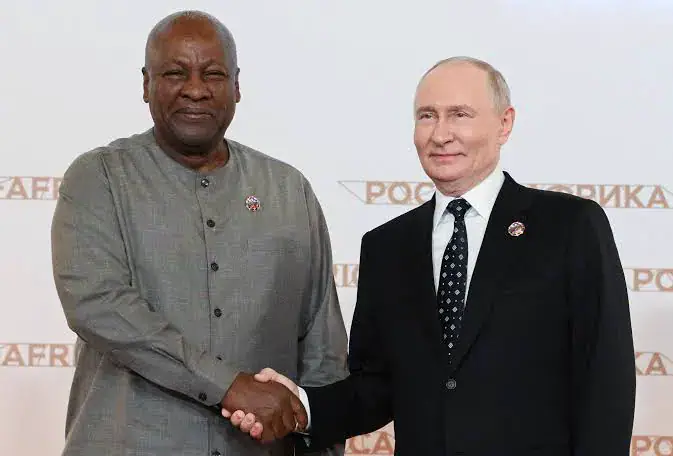
President John Dramani Mahama announced that Ghana has started discussions with Russia's state-owned nuclear energy corporation, Rosatom, to establish the country's first nuclear power station. This development was disclosed during the third Russia-Africa Summit in Moscow, chaired by Russian President Vladimir Putin. The President emphasized that a reliable and affordable electricity supply is crucial for industrial growth, particularly in Ghana's efforts to expand domestic manufacturing and process mineral resources locally.
Ghana is pursuing a diversified energy strategy that incorporates renewable sources alongside nuclear power to strengthen electricity supply and support long-term economic transformation. The President highlighted Russia's experience in nuclear technology as an opportunity for cooperation as Ghana lays the groundwork for the peaceful application of nuclear energy. He noted that dependable and reasonably priced electricity is essential for industrial growth, especially as Ghana seeks to create more economic opportunities for its population.
Mr. Mahama recalled the longstanding nuclear cooperation between Ghana and Russia, dating back to 1964 when the Soviet Union supplied Ghana with a two-megawatt nuclear reactor for scientific research. Ghanaian nuclear scientists have also received training in Russia to operate the research reactor, highlighting the historical foundations for further cooperation in nuclear science and technology. This cooperation could lead to the development of Ghana's first nuclear power station.
The proposed nuclear power station is part of a broader effort to deepen Ghana's economic relationship with Russia across energy, agriculture, trade, and technology. President Mahama invited Russian businesses to explore partnerships with Ghanaian enterprises in various sectors, including fertiliser manufacturing, agricultural machinery, pharmaceutical production, infrastructure development, and the digital economy. He emphasized the need to translate diplomatic relations into practical economic benefits.
On agriculture, Mr. Mahama highlighted Russia's capabilities in fertiliser production, agricultural equipment, and scientific research as areas that could support Ghana's efforts to improve farm productivity and enhance food security. Cooperation in these fields could address some of the constraints facing agricultural development while creating opportunities for technology transfer, local investment, and improved production methods. This collaboration could have a positive impact on Ghana's agricultural sector.
President Mahama also called for concrete measures to expand trade between Russia and African countries, including improved access to markets for African products and the exploration of arrangements that facilitate legitimate commercial transactions through local currencies and digital payment systems. He suggested that such mechanisms could make trade settlements more convenient and encourage greater commercial engagement between African and Russian businesses.
The next stages of engagement will determine how the discussions with Rosatom develop and whether the proposed partnership advances towards a formal agreement and the practical steps required to establish Ghana's first nuclear power station. Details of the proposed plant's financing, capacity, location, construction schedule, and eventual operational date have not been established. The discussions do not amount to confirmation that a final construction agreement has been concluded.
Key points
- Ghana initiates talks with Russia's Rosatom to establish its first nuclear power station as part of a diversified energy strategy.