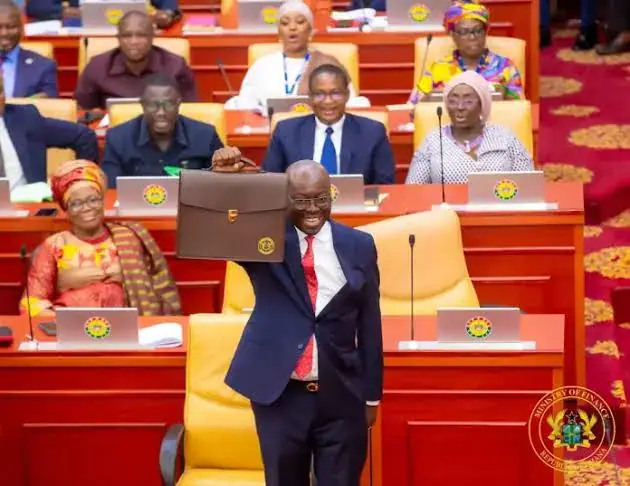
The Ghanaian government has projected a total expenditure of GH¢389.2 billion for the 2027 financial year, representing 21.6% of the country's Gross Domestic Product (GDP). This projection was announced by Finance Minister Dr. Cassiel Ato Forson during the presentation of the 2027 Budget Statement and Economic Policy to Parliament on November 12. The expenditure plan emphasizes increased investment in infrastructure, human capital, and key economic sectors.
The government's expenditure estimate for 2027 is expected to be financed by total revenue and grants amounting to GH¢323.4 billion, which is equivalent to 17.9% of GDP. This financing plan is projected to result in an overall cash deficit of GH¢65.8 billion, or 3.6% of GDP. A significant portion of the expenditure, GH¢100.4 billion, is allocated for direct capital spending, representing 5.6% of GDP. When including transfers to other government units, total capital spending is expected to rise to GH¢120.5 billion.
The breakdown of the government's expenditure shows that compensation of employees constitutes the largest component, with an allocation of GH¢104.1 billion. This includes GH¢92.6 billion for wages and salaries, and GH¢11.5 billion for social contributions, pensions, and gratuities. Additionally, the government has set aside GH¢76.5 billion for statutory and earmarked transfers, while interest payments are estimated at GH¢61 billion. This includes GH¢51.5 billion in domestic interest and GH¢9.5 billion in external interest.
The budget also outlines specific allocations for various sectors. Education takes the largest share with GH¢48 billion earmarked for the sector, including GH¢11.2 billion for the Ghana Education Trust Fund (GETFund) and GH¢1.37 billion towards ending the double-track system in senior high schools. The health sector has been allocated GH¢40.3 billion, which includes GH¢10.2 billion for the National Health Insurance Scheme (NHIS) and GH¢6.8 billion to commence the construction of 11 new hospitals.
The Gender and Social Protection sector is set to receive GH¢3.4 billion, with GH¢2.1 billion intended for the School Feeding Programme and GH¢1.1 billion for the Livelihood Empowerment Against Poverty (LEAP) programme. Furthermore, under its flagship economic transformation initiatives, the government has allocated GH¢30 billion to the New Economy Programme and GH¢29.8 billion to the Big Push infrastructure programme.
A significant portion of the Big Push allocation, GH¢28 billion, will come directly from the central government budget. The Roads and Highways sector is also expected to receive substantial funding, although specific details on the allocation were not provided. The government's spending framework places greater emphasis on productive investment, aiming to boost economic growth and development.
Other allocations include GH¢13.9 billion towards settling outstanding arrears, including GH¢4.3 billion owed to Independent Power Producers (IPPs). Additionally, GH¢13.7 billion has been allocated for goods and services, while social benefits have been allocated GH¢2.3 billion. The government also set aside GH¢17.2 billion for other expenditure, covering items such as energy sector shortfalls and GoldBod transfers.
Key points
- The government has allocated GH¢100.4 billion for direct capital expenditure, representing 5.6% of GDP.
- Education and health sectors receive significant allocations, with GH¢48 billion and GH¢40.3 billion respectively.
- The budget outlines an overall cash deficit of GH¢65.8 billion, or 3.6% of GDP.
Reporting sources
- Gov’t Projects GH¢389.2bn Expenditure for 2027 · Q125133036