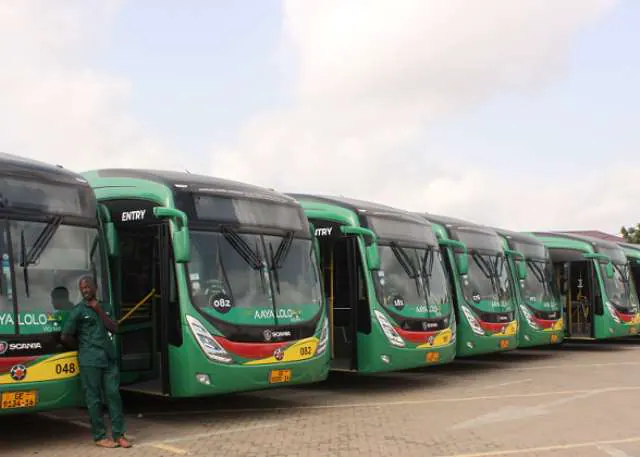
The Government of Ghana has introduced a contra-flow traffic arrangement for Aayalolo Bus Rapid Transit services in a bid to improve public transportation and alleviate traffic congestion in Accra. This new arrangement, which took effect on September 29, 2026, will initially cover three major corridors: Amasaman–Accra, Adenta–Accra, and Kasoa–Accra. These corridors will be subject to the contra-flow system during peak commuting periods.
The contra-flow system will operate between 6 a.m. and 9 a.m. in the morning and 4 p.m. and 8 p.m. in the evening, coinciding with the highest traffic volumes on the selected corridors. Under this arrangement, specific sections of the roads will be temporarily configured to allow authorized Aayalolo buses to travel in the oncoming traffic lanes, designated as contra-flow lanes. These lanes will be exclusively reserved for Aayalolo buses.
The initiative is being championed by the Ministry of Local Government, Chieftaincy and Religious Affairs, in collaboration with the Greater Accra Passenger Transport Executive (GAPTE) and other stakeholders. The Managing Director of GAPTE, Daouda Awudu, explained that the contra-flow system aims to address one of the major challenges confronting the Aayalolo system: unpredictable journey times due to traffic congestion. The Aayalolo buses often get caught in the same traffic as other vehicles, leading to delays.
The contra-flow system involves temporarily allocating road space to Aayalolo buses, particularly where there is available capacity on the opposite side of the road. This allows the buses to move through congested sections without being trapped in the normal traffic flow. Mr. Awudu emphasized that contra-flow should not be confused with the use of motorcycle escorts for Aayalolo buses, as they are different traffic management interventions.
An earlier trial conducted along the Kinbu–Adenta route demonstrated the potential of the contra-flow system to significantly reduce journey times. During the trial, travel time on the route, which could take almost two hours under heavy traffic conditions, was reduced to about 45 minutes when Aayalolo buses were given a dedicated movement path through congested areas. This trial showcased the effectiveness of the contra-flow system in improving public transportation.
The Motor Traffic and Transport Department (MTTD) of the Ghana Police Service will deploy personnel to strategic locations and major intersections to manage traffic and enforce compliance with the contra-flow arrangement. Private cars, taxis, trotros, commercial vehicles, and other unauthorized vehicles will not be permitted to use the designated contra-flow lanes. The contra-flow system is expected to support the deployment of 126 repaired Aayalolo buses.
The initiative follows calls by the Minister for Local Government, Chieftaincy and Religious Affairs, Mahama Ayariga, for reforms to improve public transportation in Accra. With the introduction of the contra-flow system and dedicated bus lanes, Aayalolo buses will be able to make more trips instead of spending long periods in traffic, thereby enhancing the overall efficiency of public transportation in Accra.
Key points
- The contra-flow system will initially cover three major corridors in Accra.
- The system will operate during peak commuting periods.
- The initiative aims to reduce traffic congestion and improve public transportation in Accra.