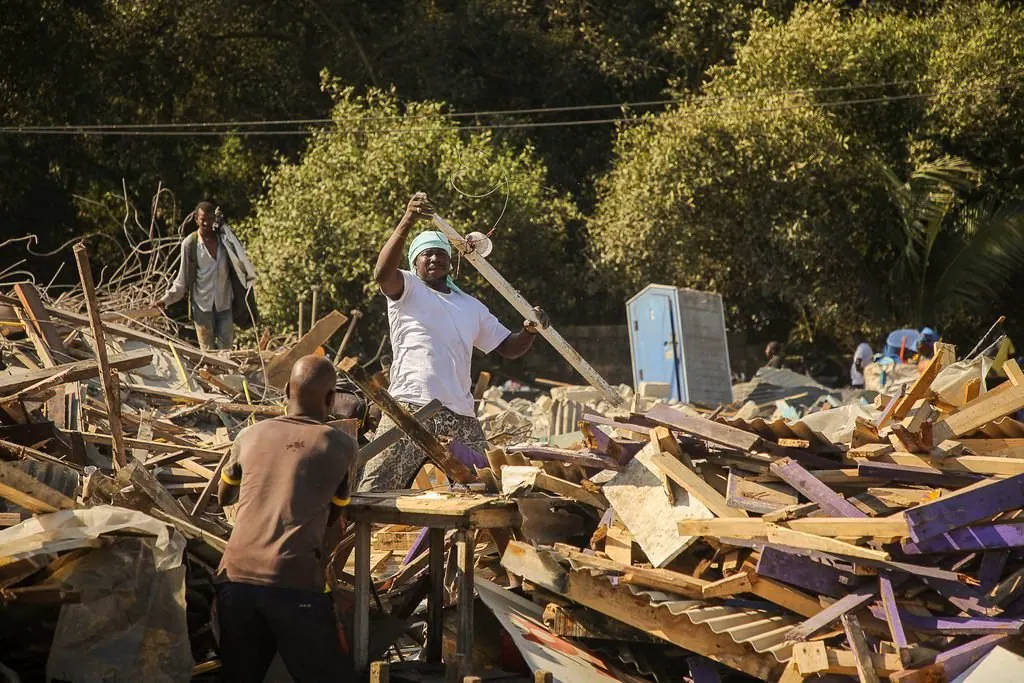
On October 2, 2026, joint security forces surrounded La Pleasure Beach Resort in Accra, Ghana, before dawn. By 4am, bulldozers had begun demolishing the area, including Vienna City Club, Polo Beach Club, shops, stalls, and pub sheds. The operation involved officers from the Ghana Police Service, Military Police, the Fifth Battalion, and the 48 Engineer Regiment. Vendors and patrons reacted with anger, stating they had not been informed of the exact date of the demolition and were unable to retrieve their belongings.
The demolition follows an earlier clearance at Laboma Beach Resort on September 13, 2026, as part of the Post-Flood Mitigation Task Force's efforts to restore the Kpeshie Lagoon and curb flooding in Accra. Authorities framed the exercise as necessary to protect public infrastructure and reduce flood damage risk in La, Osu, and Teshie communities. The Social Security and National Insurance Trust (SSNIT) cited security concerns and damage to the coastal ecosystem as justification for removing structures nearby.
For many traders, La Pleasure Beach was not just a workplace but a livelihood passed down over generations. One operator stated that businesses had operated at La Pleasure Beach for generations, supporting people beyond those directly employed. Some vendors claimed they received no warning, while a single mother stated she and her colleagues had been given two weeks to vacate but did not believe the order would be enforced.
The scale of disruption appears significant, with many people rendered jobless. The Member of Parliament for the area, Rita Naa Odoley Sowah, and the Municipal Chief Executive, Alfredos Nii Anyetei, acknowledged the impact on informal economic activity in La, Osu, and Teshie communities. Research estimates that around 89 percent of employment in Ghana is informal, meaning most workers have no formal contracts, pension coverage, or legal recourse.
A 2024 study by Alex Anlesinya and Gerald Joseph Tetteh Nyanyofio found that informal workers in Accra's markets described income as inseparable from survival, with little savings or access to credit. Losing a trading space threatens not just income but a worker's sense of dignity, social belonging, and ability to educate their children. The study's findings are instructive in understanding the impact of the demolition on affected workers.
The demolition raises legal and constitutional questions regarding property protection, compulsory acquisition, and the right to work under safe conditions. Ghana's 1992 Constitution provides protections around property, while Article 18(2) permits lawful interference with property where reasonably required for town planning or public safety. The Land Use and Spatial Planning Act, 2016 (Act 925), also carries sanctions for unauthorised development.
This is the second major beachfront clearance in Accra within roughly three weeks. Authorities face intensified calls to set out clearer rules on notice, compensation, and relocation before future clearances. There is currently no published timeline for compensation, relocation, or an independent review of the La Pleasure Beach demolition.
Key points
- The demolition of La Pleasure Beach and Polo Beach Club has left many traders jobless and questioning state responsibility.
- The exercise was part of efforts to restore the Kpeshie Lagoon and curb flooding in Accra.
- The demolition raises legal and constitutional questions regarding property protection and the right to work under safe conditions.