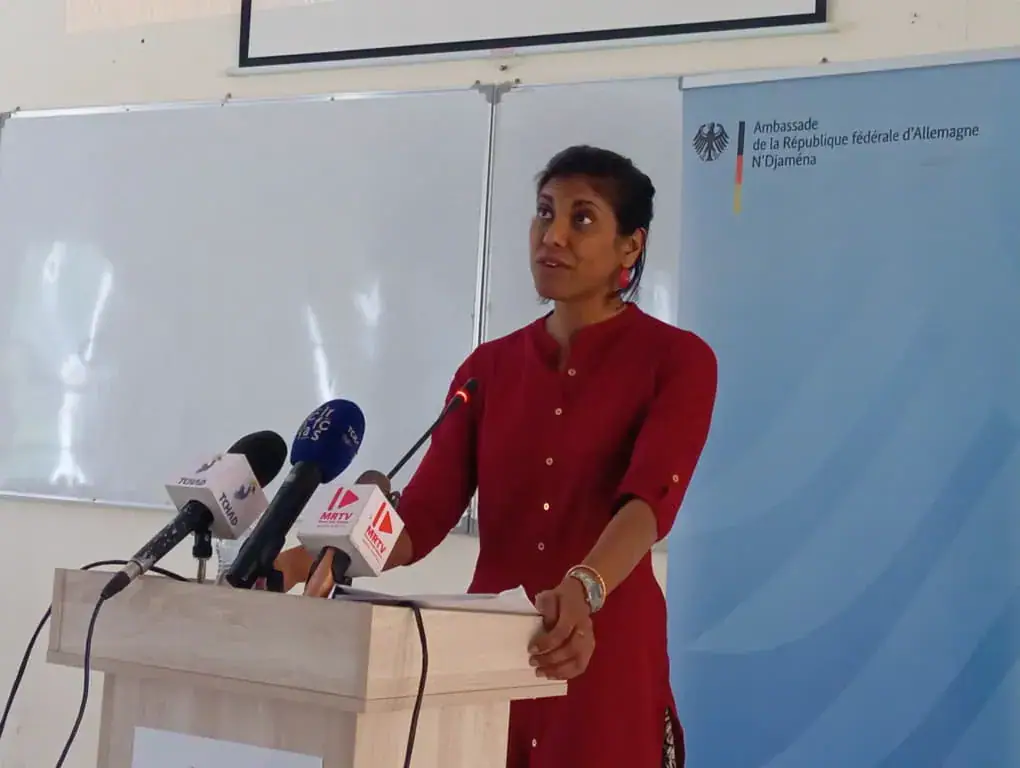
The German embassy in Chad organized a conference on November 24, 2026, at the University of N'Djamena's Faculty of Human Health Sciences, to discuss the nexus between climate, peace, and security in the Lake Chad Basin. The event featured Janani Vivekananda, a researcher specializing in climate change, peace, and security. The conference presented the findings of the "Shoring up Stability" report, an independent study supported by the UN Development Programme, the Dutch and German foreign ministries.
The report, which resulted from two years of research in Cameroon, Chad, Niger, and Nigeria, revealed that the Lake Chad Basin is trapped in a "conflict trap" where violence, poverty, poor governance, and climate change reinforce each other. According to Vivekananda, instability in the region transcends national borders, forming a vast arc of fragility that includes the Sahel and the Horn of Africa. The study highlighted that the Lake Chad Basin faces significant challenges, including the impact of climate change on water availability and agricultural productivity.
Contrary to popular perception, the Lake Chad is not currently on the verge of disappearing. After losing nearly 90% of its surface area during the 1970s and 1980s droughts, the lake has experienced an increase in size since the 1990s, mainly due to improved precipitation in the western Sahel. Research indicates that the water area in the southern basin has remained relatively stable or even increased when including areas covered by vegetation. However, the northern basin has seen a slight decrease in surface water, punctuated by episodes of drying followed by recovery with the return of rains.
The study identified four key factors driving the crisis in the region. The first factor is the degradation of livelihoods due to the combined effects of conflict and climate change. The displacement of people, restrictions on movement, and disruption of commercial exchanges have weakened agricultural, pastoral, and fishing activities, exacerbating food insecurity. The second factor is the increased competition for natural resources, particularly land, water, and forest areas.
The third factor is the recruitment and retention of young people in armed groups. Poverty, inequality, lack of economic prospects, social frustrations, and violence contribute to the dynamics of recruitment of groups like Boko Haram and the Islamic State in West Africa. For some individuals, these groups represent a source of income, a sense of belonging, and a form of social recognition. The fourth factor concerns the consequences of military responses on civilian populations.
The report recommends ten areas of intervention to strengthen peace and resilience in the Lake Chad Basin. These include promoting social cohesion, supporting resilient livelihoods, improving access to basic social services, and combating gender inequality and human rights violations. The report also suggests strengthening communities' adaptation capacities to climate change, improving access to climate and hydrological information, and developing information and communication technologies.
The conference aimed to inform the discussion on strategic challenges facing the Lake Chad Basin and promote sustainable responses to address the region's multiple and interconnected challenges. The exchanges highlighted the need to move beyond solely security-oriented responses and integrate climate, economic, social, and institutional issues into stabilization and peacebuilding policies. The goal is to promote durable solutions that can strengthen community resilience and prevent conflicts in the region.
Key points
- The Lake Chad Basin is trapped in a "conflict trap" where violence, poverty, poor governance, and climate change reinforce each other.
- The region faces significant challenges, including the impact of climate change on water availability and agricultural productivity.
- The report recommends ten areas of intervention to strengthen peace and resilience in the Lake Chad Basin.