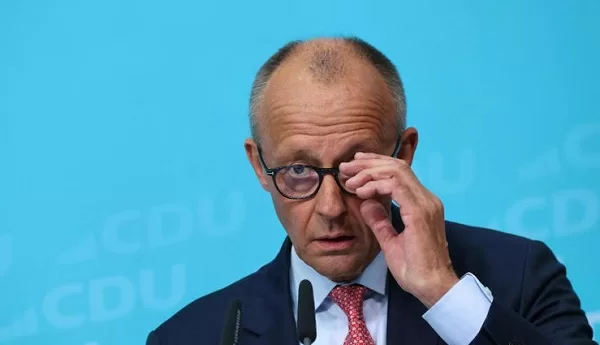
On Sunday, millions of German voters will cast their ballots in two significant regional elections in Berlin and Mecklenburg-Western Pomerania. These elections may have far-reaching implications for Chancellor Friedrich Merz, who is already facing challenges. The voting process began at 8:00 AM local time and will conclude at 6:00 PM GMT. Initial estimates are expected to be released shortly after the polls close. Merz has called an emergency meeting of his conservative party, the CDU, to discuss the election results.
Chancellor Merz, 70, has been dealing with a series of setbacks, including a recent defeat for his party in the state of Saxony-Anhalt. The far-right Alternative for Germany (AfD) party secured a significant victory in that election, which has raised concerns about Merz's leadership. In response to the anticipated repercussions of the current elections, Merz has canceled his planned trip to New York for the United Nations General Assembly. His party's popularity is at an all-time low, and he faces difficulties in implementing promised economic reforms with his coalition partners, the Social Democrats.
According to recent polls, the AfD is expected to make gains in the upcoming elections, although not as substantial as in Saxony-Anhalt. In Mecklenburg-Western Pomerania, the AfD is projected to secure 37% of the vote, while the Social Democratic Party (SPD), led by the popular regional president Manuela Schwesig, is expected to receive 35%. The CDU, however, is struggling to reach the 5% threshold required for representation in the regional parliament.
The elections in Mecklenburg-Western Pomerania are seen as a duel between the SPD and the AfD, with the CDU being a distant third. The region, located on the Baltic Sea, has been a stronghold for the SPD, and Schwesig's popularity is expected to play a significant role in the outcome. The AfD's success in the region would be a further blow to Merz's leadership and could potentially lead to increased instability in the German government.
The CDU's struggles are not limited to Mecklenburg-Western Pomerania, as the party is also facing challenges in Berlin. In the capital city, the AfD is expected to make significant gains, which could have implications for the city's government. The CDU's poor performance in the elections could lead to a re-evaluation of Merz's leadership and potentially even a change in the party's direction.
The outcome of the elections will be closely watched by European leaders, as it could have implications for Germany's role in the region. A strong showing by the AfD could lead to increased skepticism about Germany's commitment to European integration and its role in the European Union. Conversely, a strong performance by the SPD and other pro-European parties could help to alleviate concerns about Germany's leadership.
The elections in Germany are a significant test for Chancellor Merz, who has been struggling to regain the trust of the German people. The outcome will likely have far-reaching implications for his leadership and the future of the CDU. As the results are announced, European leaders will be watching closely to assess the potential impact on Germany's role in the region and its commitment to European integration.
Key points
- The AfD is expected to make significant gains in the regional elections, potentially weakening Chancellor Merz's leadership.
- The CDU is struggling to reach the 5% threshold required for representation in the regional parliament in Mecklenburg-Western Pomerania.
- The outcome of the elections could have implications for Germany's role in the European Union and its commitment to European integration.