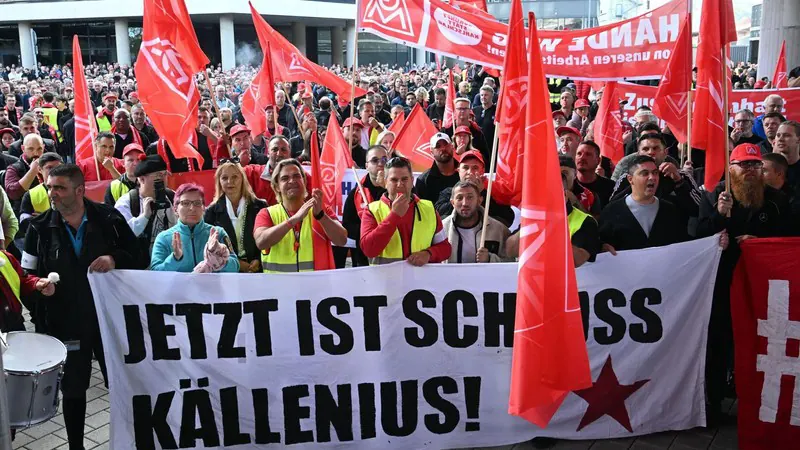
German automotive workers held mass protests across the country on Monday, calling for government and management action to safeguard jobs and factories in an industry facing significant challenges. The protests, which saw almost 180,000 people participate at over 280 sites, were organized by the IG Metall union. The industry is struggling with growing Chinese competition, weak domestic demand, and US tariffs.
The German car industry, a significant contributor to the country's economy, is undergoing a substantial restructuring. Volkswagen, one of the largest automakers in the world, plans to cut 100,000 jobs by the end of the decade, marking the biggest restructuring in global automotive history. Other major automakers, including Mercedes-Benz and BMW, are also downsizing in response to the challenging market conditions.
Workers at Volkswagen, such as Janik Hitzemann, 31, an assembly line worker at a VW plant in Hannover, are protesting to pressure management to find alternative solutions for their jobs. Hitzemann expressed concerns about the devastating impact of job losses on individuals and their families. The IG Metall union is pushing for government support, including cheaper energy, financial help for suppliers, and "Made in EU" rules to promote domestic production.
Christiane Benner, the leader of IG Metall and a member of VW's supervisory board, addressed workers at VW's iconic Wolfsburg factory, stating that the industry is facing a critical situation. Benner criticized management for being slow to adapt to the changing market, particularly in the transition to electric vehicles and investment in software. She called on the government to provide comprehensive welfare and industrial policy support to protect workers.
The protests reflect deep-seated concerns about the future of the automotive industry, according to Wolfgang Schroeder, a political scientist at the University of Kassel. Schroeder noted that the nationwide action, not related to pay negotiations or specific disputes, is a rare occurrence and a manifestation of real fear over the industry's future. Daniela Cavallo, the head of VW's works council, warned workers that the industry will undergo significant changes, with some carmakers potentially falling behind or merging.
German Finance Minister Lars Klingbeil has pledged to press for the European Union to provide further protection for the continent's carmakers from Chinese competitors. Klingbeil emphasized the need for the EU to be cautious and not "naive" in its approach to the global car industry. The IG Metall union is seeking a fair distribution of sacrifices among workers, with Cavallo stressing that the burden should be shared collectively.
The protests highlight the significant challenges facing the German automotive industry, with over 100,000 jobs at risk. The industry's struggles have far-reaching implications for the German economy and workers' livelihoods. As the industry continues to evolve, workers, management, and government will need to work together to find solutions that balance the needs of all stakeholders.
Key points
- Almost 180,000 people participated in the protests at over 280 sites across Germany.
- Volkswagen plans to cut 100,000 jobs by the end of the decade.
- The IG Metall union is calling for government support, including cheaper energy and financial help for suppliers.