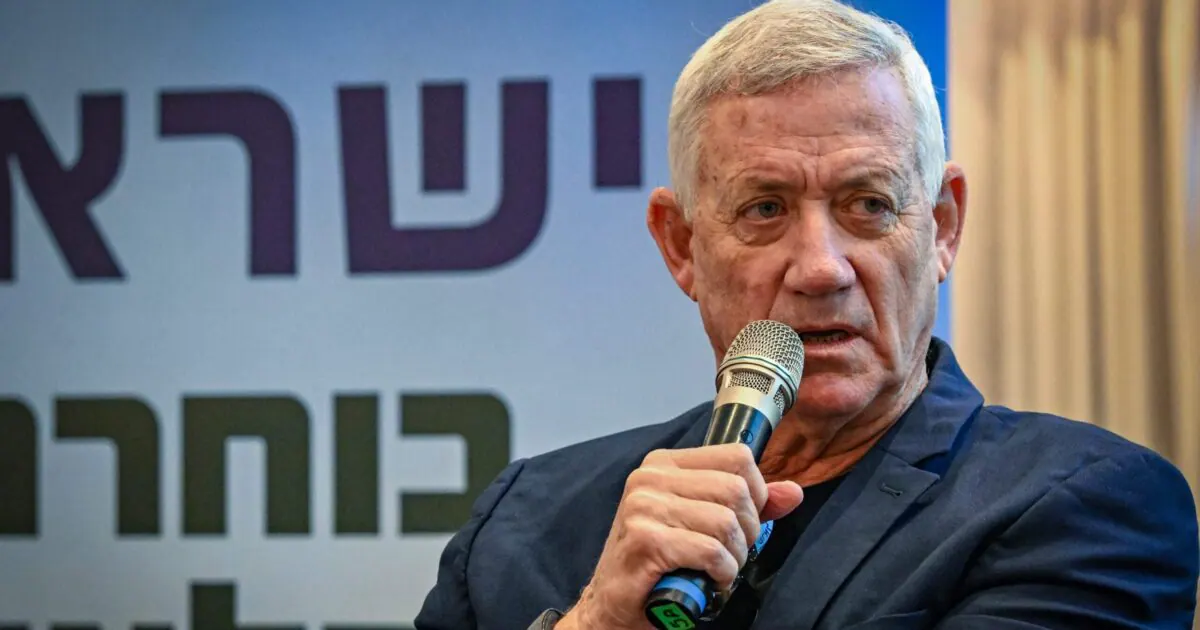
Israeli politician Benny Gantz has emphasised the need for a broad, moderate Zionist government to address the country's challenges. In an article published by JTA, Gantz noted that Israel is approaching a critical moment, with serious threats including a decline in global standing, rising antisemitism, and internal divisions. He stressed that the country's leaders must not deepen existing divides. Gantz's comments come ahead of the October 27 elections, with polls suggesting a potential political deadlock.
Gantz highlighted the importance of Israel's relationship with the United States, citing a warning from California Congressman Brad Sherman about the erosion of support for Israel in America. He noted that rhetoric from radical figures, such as National Security Minister Itamar Ben-Gvir, can damage Israel's standing. Gantz urged Israelis to take Sherman's warning seriously, stressing that the US-Israel alliance must not be held hostage to partisan politics. He emphasised that the alliance must be strong enough to endure changes in administrations and congressional majorities.
A broad, moderate Zionist government would enable Israel to address its fundamental national challenges, Gantz argued. He believes that such a government, stretching from the responsible right to the responsible left, would be strong enough to govern without dependence on political radicals. This, he stressed, is not simply a matter of coalition politics but a strategic necessity. Gantz's vision for a broad Zionist government involves containing serious disagreements between right, centre, and left while sharing basic responsibilities.
Gantz also emphasised the importance of Israel's relationship with American Jewry, noting that American Jews should not have to support every Israeli minister or government to demonstrate their support for Israel. He argued that criticism of a political vision is not a rejection of the Jewish State. Gantz stressed that Israel must protect the dialogue over its shared future with American Jews, who remain outside Israel's democratic arena.
The Western Wall, a site of significant religious importance, has become a source of division between Israel and Jews abroad, Gantz noted. He argued that narrow coalition politics have allowed the question of how Jews can pray there to become another source of division. Gantz previously stated that the Western Wall is large enough to accommodate everyone, emphasising the need for a more inclusive approach.
Gantz cited the Abraham Accords as an example of what can be achieved through a more moderate and pragmatic approach. He argued that a regional architecture connecting Israel, the United States, and moderate Arab and Muslim countries could reshape Israel's position for generations. However, Gantz stressed that Israel needs the political room to pursue such initiatives, which requires a broad and moderate government.
Gantz concluded that Israel's problem is not that the majority of Israelis have become radical but that the political system repeatedly gives radical minorities power far beyond their public support. He urged that, for the sake of Israel's future and Jewish unity, it is essential to restore political power to the broad moderate majority and ensure that narrow political interests do not outweigh the wider national interest.
Key points
- Gantz urges need for broad, moderate Zionist government
- Erosion of US support for Israel a serious concern
- Internal divisions pose significant threat to Israel's future