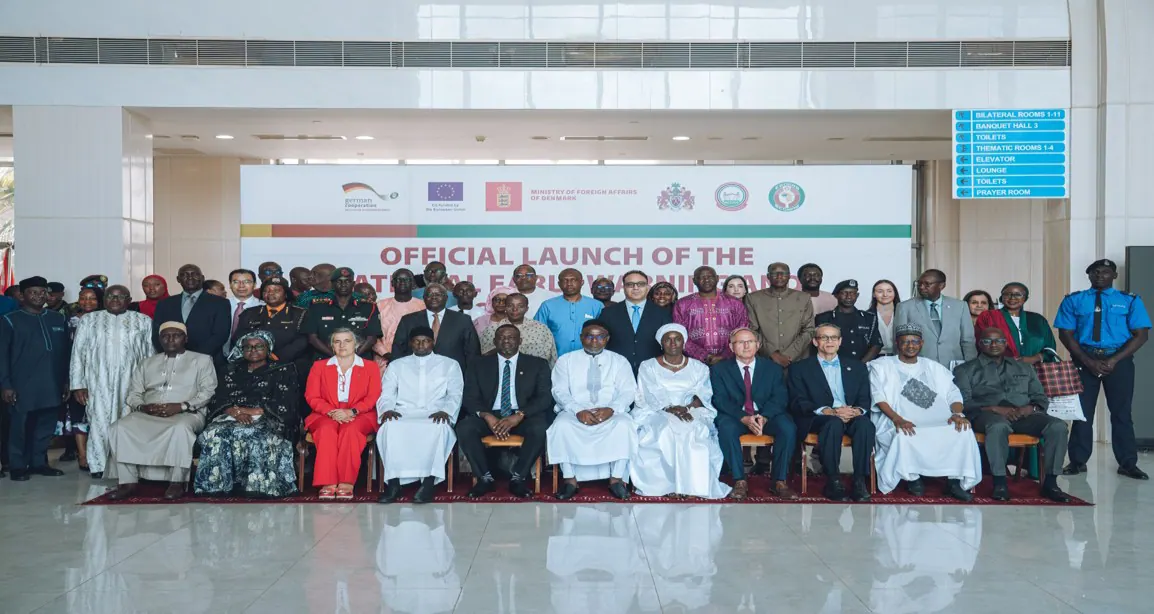
The Government of Gambia and the European Union have officially launched the National Early Warning and Response Policy 2026-2035. This policy aims to provide a national framework for strengthening early warning systems, enhancing coordinated responses, and safeguarding peace and human security. It was launched through the National Early Warning and Response Mechanism Coordinating Centre. The policy provides guidelines for monitoring risks across various sectors.
The policy establishes mechanisms for timely response and aligns with ECOWAS regional frameworks and international best practices. It is now the official reference document guiding national and partner interventions in early warning and response. Stakeholders are encouraged to align their strategies and programming with the policy. This will ensure coherence and sustainability in early warning and response efforts.
The launch event was attended by high-profile individuals, including the Vice President of Gambia, Mohammed B.S. Jallow, and the European Union Ambassador, Imma Roca i Cortés. Other attendees included senior government officials, ECOWAS representatives, and development partners. Vice President Jallow emphasized the importance of early warning and response in maintaining national peace and security.
Vice President Jallow noted that risks facing societies today are increasingly complex and interconnected. He stated that early warning and response are essential to national peace and security. The policy provides a framework for moving from a culture of reaction to one of anticipation, prevention, and preparedness. This shift is expected to enhance the country's ability to respond to crises.
EU Ambassador Imma Roca i Cortés highlighted the importance of crisis preparedness in contributing to stability and sustainable peace. She emphasized that anticipating risks and acting early can actively contribute to stability and sustainable peace. The European Union is committed to supporting Gambia's early warning and response efforts.
The Director General of the National Early Warning and Response Mechanism Coordinating Centre, Binta Singhateh, stressed that early warning and response require strong collaboration across government, local authorities, and communities. She noted that it is not the responsibility of one institution alone. The Centre was established in 2019 and operates under the National Early Warning and Response Mechanism Act, 2025.
The development of the policy was supported by the EU Support to ECOWAS in Peace, Security and Governance Project. This project was commissioned by Germany and co-financed by the EU and Denmark. The policy's launch marks a significant milestone in Gambia's efforts to strengthen its early warning and response systems. Key stakeholders will receive technical guidance on integrating the policy into their operations.
Key points
- The policy provides a national framework for strengthening early warning systems and enhancing coordinated responses.
- The launch event was attended by high-profile individuals, including the Vice President of Gambia and the European Union Ambassador.
- The policy aligns with ECOWAS regional frameworks and international best practices.