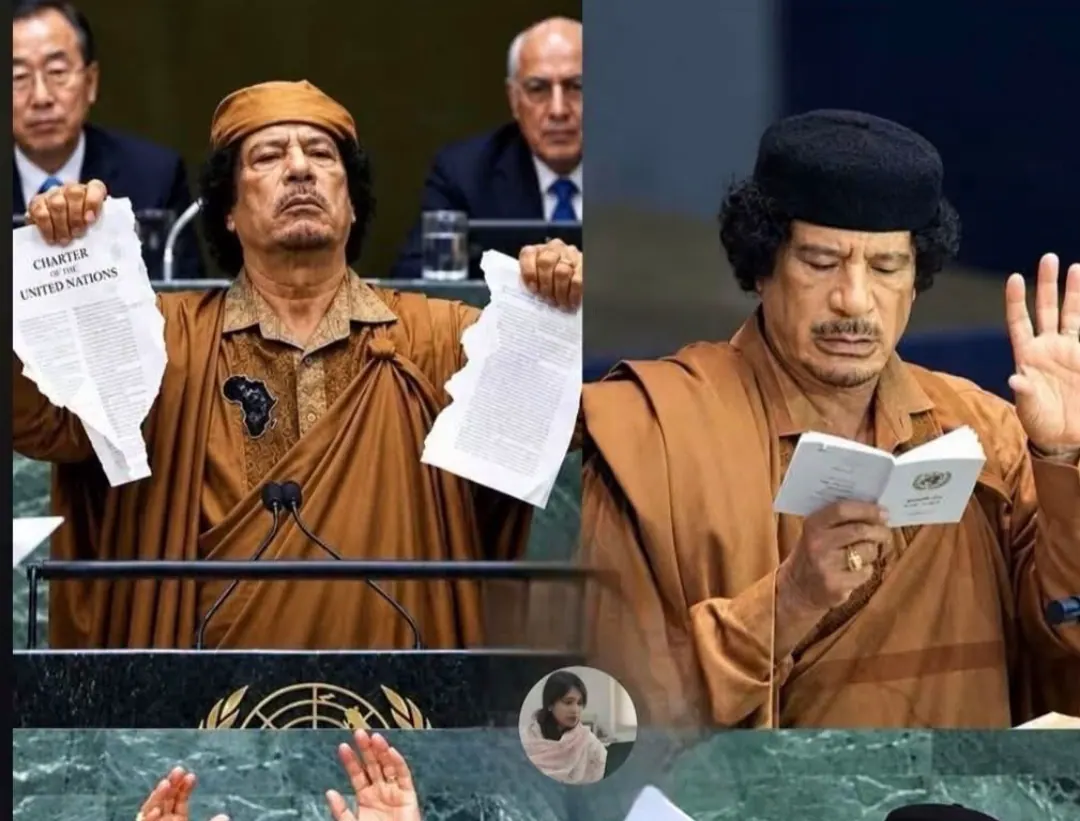
On September 23, 2009, Muammar Gaddafi, the then Libyan leader, walked into the United Nations General Assembly in New York, not to deliver a short diplomatic address as expected, but to turn the world's most important diplomatic chamber into a stage for one of the most extraordinary speeches in its history. Gaddafi's address lasted approximately one hour and 36 minutes, making it dramatically longer than the usual 15-minute speaking allocation for leaders during the General Debate. This was his first visit to the United States and his first appearance at the UN General Assembly.
Gaddafi's speech ranged across some of the most controversial issues in international politics, including the Iraq War, the assassination of former US President John F. Kennedy, the Israeli-Palestinian conflict, colonialism, and the structure of the UN Security Council. He questioned why five permanent members—the United States, Britain, France, Russia, and China—possessed veto powers that could block decisions supported by the wider membership. Gaddafi argued that the system gave disproportionate influence to major powers while leaving smaller countries with limited ability to shape international decisions.
The Libyan leader called for investigations into major wars and international crises, including the Iraq War. He also raised questions about the origins of the H1N1 influenza outbreak, suggesting that it might have been connected to biological research. Furthermore, Gaddafi demanded that the circumstances surrounding the former American president's death be investigated. His speech was a bold move that challenged the status quo and sparked intense debate.
One of the most dramatic moments came when Gaddafi held up a copy of the United Nations Charter and criticized the gap between its principles and the actual distribution of power in international affairs. Contemporary reports said he tore the document while making his argument, a scene that became one of the most remembered images from his appearance. The speech was so long that it became a story in itself, with the Libyan interpreter eventually becoming exhausted and another interpreter having to take over.
Gaddafi's New York visit was not only controversial inside the UN chamber but also outside the headquarters. His entourage attempted to establish one of his famous Bedouin-style tents, but after efforts involving locations in New Jersey and Manhattan failed, a tent was erected on property connected to Donald Trump in Bedford, New York. However, local authorities ordered work stopped because the structure lacked the necessary approvals, and the tent was subsequently dismantled.
The bizarre combination of the tent controversy and the marathon UN speech made Gaddafi's 2009 American visit unforgettable. Yet beneath the spectacle was a serious political argument. Gaddafi was challenging the architecture of global power itself, arguing that the international system claimed to represent sovereign equality while giving extraordinary privileges to a handful of powerful states. His central complaint was that smaller countries had limited ability to shape international decisions.
Gaddafi's political legacy remains deeply controversial, and his rule ended with his overthrow and death in 2011. However, his extraordinary 2009 appearance at the United Nations remains one of the institution's most memorable spectacles—a 96-minute confrontation with the global diplomatic establishment that turned a routine General Assembly address into international theatre. The speech forced attention onto questions that remain part of international debate: Who gets to make decisions? Who has the power to block them? And how much influence should smaller countries have in a system dominated by major powers?
Key points
- Gaddafi's speech challenged the structure of the UN Security Council and questioned the veto powers of its five permanent members.
- The Libyan leader called for investigations into major wars and international crises, including the Iraq War and the assassination of former US President John F. Kennedy.
- Gaddafi's 96-minute speech at the UN General Assembly sparked intense debate and forced attention onto questions of global power and influence.