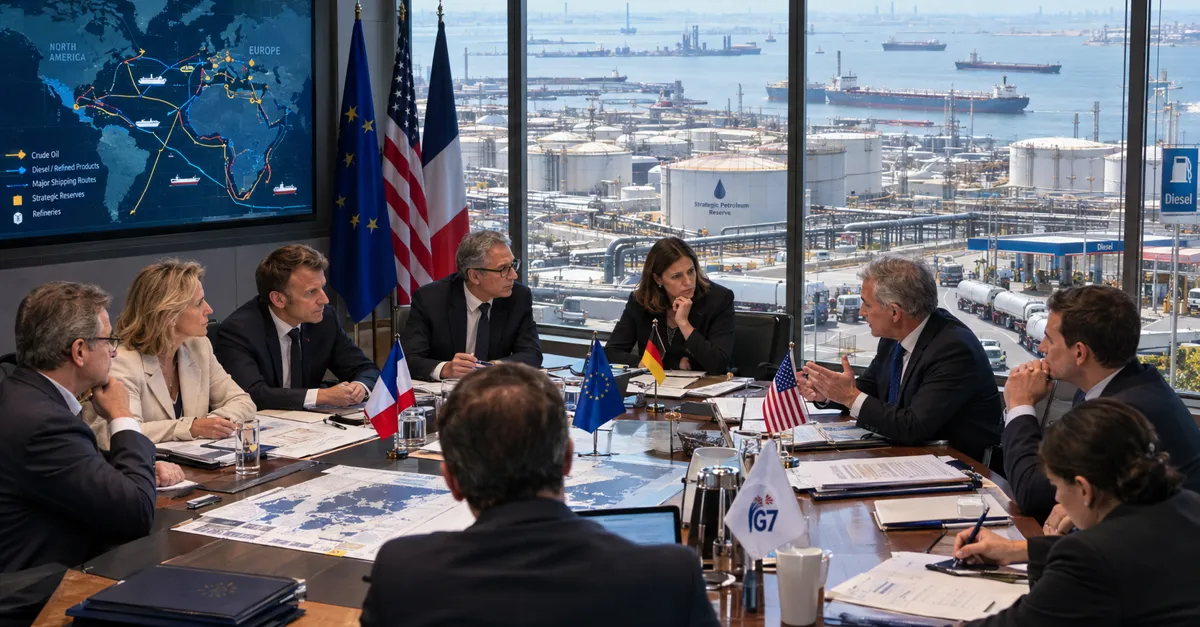
The Group of Seven (G7) major economies have agreed to release 100 million barrels of oil from their strategic reserves over the next four months. This decision was made after intense US pressure on European allies to tap into their diesel fuel stockpiles. According to a report by Politico, the announcement was made in a joint statement following an emergency meeting. The release will start immediately, with diesel fuel being prioritized.
The US had been pushing for a larger release, with Energy Secretary Chris Wright reportedly asking European countries to release 120 million barrels over three months. Wright warned that if they refused, the US might impose restrictions on fuel exports. This threat was seen as a high-pressure tactic, given that US diesel fuel covers over half of Europe's imports. The G7 statement explicitly stated that there would be no restrictions on exports among member countries.
France played a key role in negotiating the agreement, with President Emmanuel Macron proposing a release of 50 million barrels of crude oil and 50 million barrels of diesel fuel. However, Germany was more cautious, with one official stating that Berlin and other countries only wanted to release reserves for genuine security reasons. The US approach was also criticized for bypassing official channels and contacting individual countries directly.
Macron quickly moved to contain domestic fallout, denying that the agreement was made under pressure or threat. He described the talks as "constructive" and stated that US President Donald Trump was clear that he would not impose export restrictions. Trump, on the other hand, celebrated the agreement on his Truth Social platform, writing that Europe had agreed to release "huge quantities" of diesel fuel.
Questions have been raised about the effectiveness of the agreement, with some diplomats suggesting that it may simply reaffirm existing commitments. In March, the International Energy Agency (IEA) launched a plan to release 400 million barrels of oil, but some of these barrels reportedly failed to materialize. European countries have also criticized France and Germany for not releasing their strategic reserves.
The European Commission has stated that any release of reserves should go through the IEA, which it sees as the most suitable framework. A Commission spokesperson warned that restricting diesel fuel exports would undermine trust in the US as a reliable partner. The agreement has been seen as a significant move to ease global fuel shortages, but its impact remains to be seen.
The G7 agreement comes as fuel prices continue to rise, causing concern for politicians ahead of midterm elections. The release of strategic reserves is seen as a way to alleviate some of this pressure, but it is unclear how effective it will be in the long term. The agreement also highlights the complex relationships between the US, Europe, and global energy markets.
Key points
- The G7 has agreed to release 100 million barrels of oil from their strategic reserves over the next four months.
- The US had been pushing for a larger release, with Energy Secretary Chris Wright reportedly asking European countries to release 120 million barrels over three months.
- Questions have been raised about the effectiveness of the agreement, with some diplomats suggesting that it may simply reaffirm existing commitments.