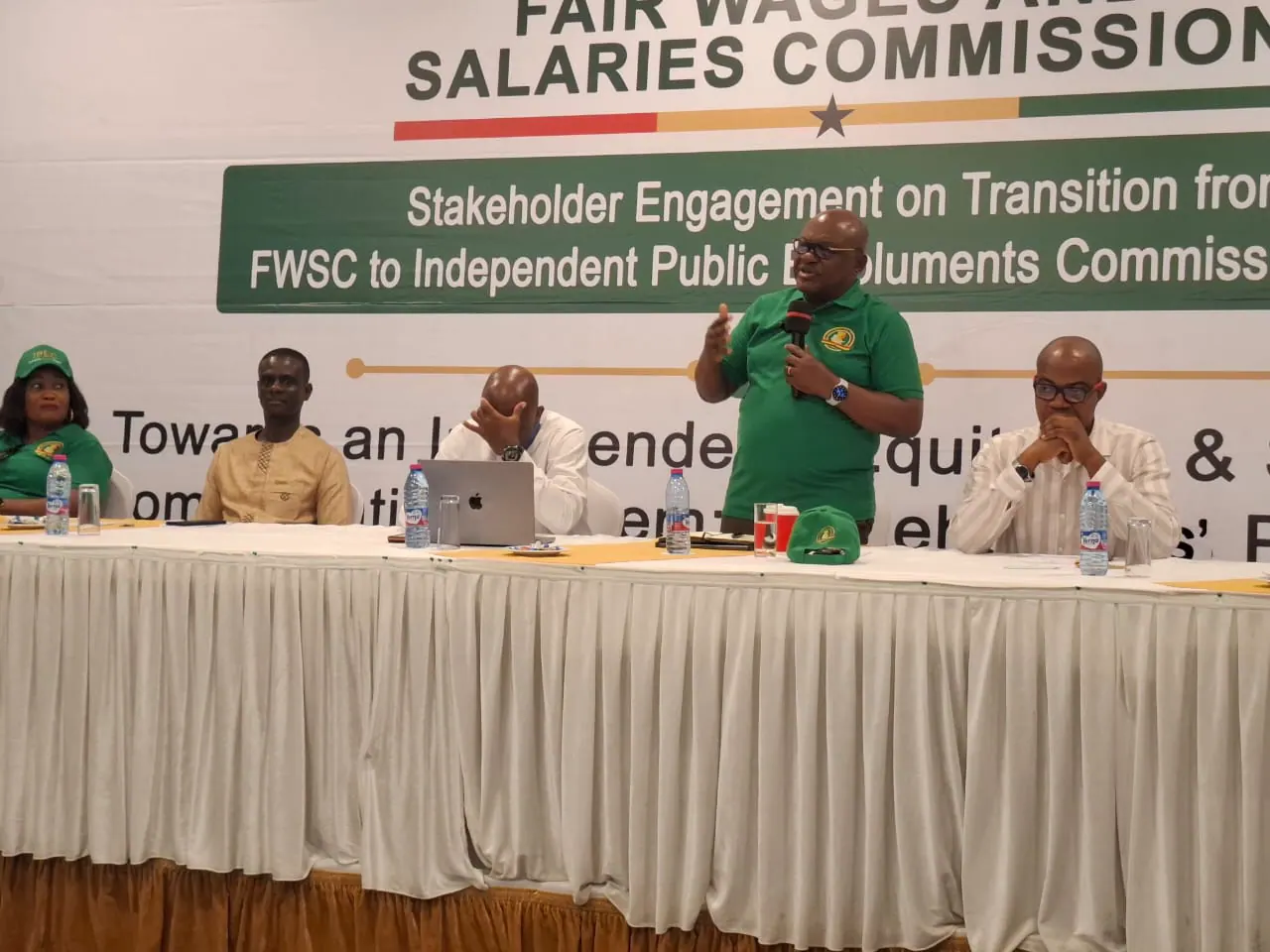
The Fair Wages and Salaries Commission (FWSC) has assured State-owned Enterprises (SOEs) in Ghana that the proposed Independent Public Emoluments Commission (IPEC) will not impose a uniform salary structure on them. This assurance was given by Dr. George Smith-Graham, the Chief Executive Officer of the FWSC, at a stakeholder engagement with heads and representatives of SOEs in Accra. The engagement was part of consultations on the transition of the FWSC into IPEC.
Dr. Smith-Graham explained that the proposed framework would take into account the financial position, size, complexity, productivity, market conditions, and capacity of individual enterprises when determining remuneration. He emphasized that SOEs that generated their own revenues and operated as commercial entities would be treated differently from institutions operating within the general public service. This distinction is crucial to ensure that enterprises can reward workers while retaining sufficient resources for operations and, where applicable, dividends to government.
The FWSC currently uses audited financial statements and a financial model to assess the capacity of SOEs to pay improved remuneration without undermining their operations. Dr. Smith-Graham cited the Gaming Commission as an example of an institution that had been weaned off government subvention and the central salary structure, and had subsequently improved its revenue generation and workers' remuneration. This example illustrates the potential benefits of the proposed IPEC framework.
The stakeholder engagement was held to solicit views on the proposed IPEC Bill, which is expected to replace the Fair Wages and Salaries Commission Act, 2007. The Bill aims to provide a national framework for public sector compensation. Dr. Smith-Graham reassured SOEs that IPEC would not take away the governance responsibilities of their boards, particularly their role in proposing remuneration for chief executives, senior managers, and other employees.
Boards of SOEs will continue to develop and submit remuneration proposals to IPEC. The change will be in the governance framework within which such proposals are considered. Dr. Smith-Graham emphasized that equity does not mean everybody must be paid the same, but rather that differences in remuneration should have an objective, transparent, and defensible basis. IPEC will work closely with the State Interests and Governance Authority to ensure effective oversight.
Minister for Labour, Employment and Job Creation, Mr. Emmanuel Kwadwo Agyekum, urged SOEs to contribute to the consultation to help develop a system suited to Ghana's circumstances. He emphasized that the government supports the transition and wants IPEC to provide a sustainable framework capable of supporting SOEs to attract and retain talent while ensuring accountability in the use of public resources.
The proposed IPEC is not being established solely to deal with Article 71 officeholders. The transition will involve establishing IPEC as a constitutional body, while any changes concerning Article 71 will require a national referendum. The government is seeking to ensure that the new framework is robust and can withstand the test of time.
Key points
- The proposed IPEC will consider the financial position and capacity of individual State-owned Enterprises when determining remuneration.
- IPEC will not impose a uniform salary structure on State-owned Enterprises.
- The new framework aims to provide a sustainable and equitable compensation system for public sector employees.