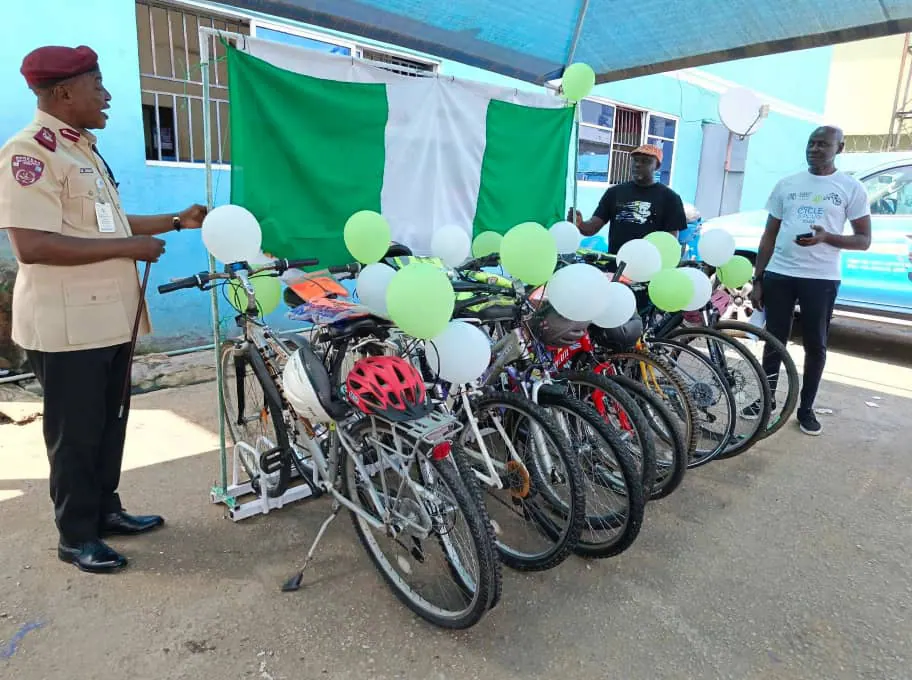
The Federal Road Safety Corps (FRSC) has partnered with the Gabriel Rotimi Aroge (GRA) Empowerment Foundation to promote safer bicycle use and sustainable mobility in Lagos. This initiative aims to reduce transport challenges and build a healthier Lagos. The partnership advocates for a collective commitment to road safety among cyclists, motorists, government agencies, and other road users.
Lagos State Sector Commander of the FRSC, Corps Commander Kehinde Hamzat, emphasized the need for a resilient city where citizens can travel safely, sustainably, and with dignity. He highlighted that Lagos, as a city of immense economic activity and population growth, must explore efficient transportation options that protect lives while preserving the environment. Bicycles, he noted, are an important component of sustainable transportation.
According to Corps Commander Hamzat, bicycles require no fuel, produce no exhaust emissions, promote physical fitness, and provide an affordable means of mobility. However, he warned that encouraging bicycle adoption without prioritizing safety would be incomplete. He urged cyclists to obey traffic rules, maintain their bicycles, use protective equipment, remain visible on the road, and avoid distractions.
The FRSC commander also appealed to motorists to respect cyclists as legitimate road users, urging them to avoid dangerous overtaking and give adequate space to bicycle riders. He emphasized that roads are shared public spaces and not battlefields, adding that no journey is important enough to justify endangering another person's life. Hamzat highlighted the role of government in creating an enabling environment for cycling.
Programmes Coordinator of the Gabriel Rotimi Aroge Empowerment Foundation, Dr. Ashiru Almoroof, said the safety session was designed to change the perception that cycling is inherently dangerous. He explained that with proper education, adherence to traffic rules, and improved awareness among motorists, cycling could become a safer and more practical means of transportation.
Dr. Almoroof noted that bicycle use could support Lagos' transportation needs through first-mile and last-mile connectivity, allowing commuters to cover short distances between their homes, bus stops, and final destinations. He added that increased bicycle adoption could help reduce traffic congestion, lower carbon emissions, improve public health, and reduce dependence on fuel-powered transportation.
The partnership aims to promote sustainable mobility through the introduction of bicycles, including electrified bicycles, as an alternative transportation option. The initiative, starting in Lagos, will eventually be expanded to other parts of Nigeria, providing a more affordable and environmentally friendly commuting option amid rising transportation costs.
Key points
- The FRSC and GRAEF partnership aims to promote safer bicycle use and sustainable mobility in Lagos.
- The initiative seeks to reduce transport challenges and build a healthier Lagos.
- Bicycles are an important component of sustainable transportation, requiring no fuel and producing no exhaust emissions.