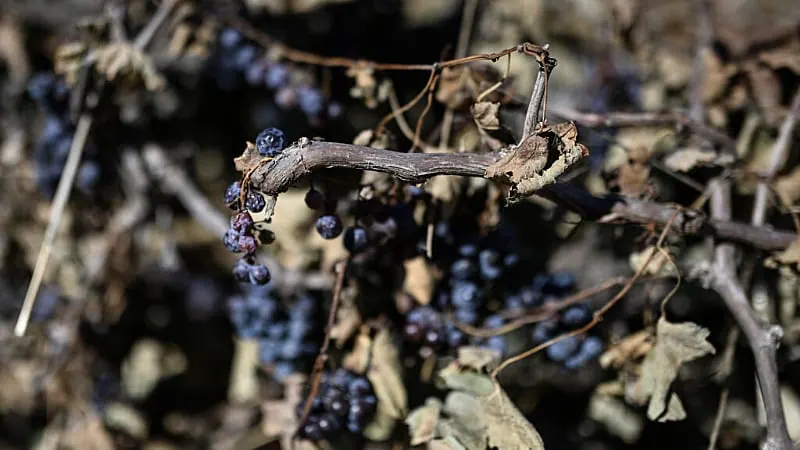
France is expected to see a historic low in its wine harvest this year, following a series of summer heatwaves that have impacted the country's wine industry. The total harvest is estimated to be around 35 million hectolitres, which is down two percent from last year's mediocre yield and 14 percent below the 2021-2025 average. This decline is attributed to the hot weather, as well as a reduction in cultivated areas, which have been pared back by 1.9 percent in the past year.
According to the International Organisation of Vine and Wine (OIV), France had already recorded its lowest production since 1957 last year. The country's wine industry has been affected by extreme weather conditions, with some regions experiencing more significant declines in production than others. The Champagne region, for example, has seen production decline by half compared to last year and the five-year average, due to growers having to harvest exceptionally early after the extreme heat sped up sugar buildup.
Despite the overall decline in production, some southern regions have seen an increase in production this year. Bordeaux, for instance, has reported a 10 percent increase in production compared to last year, although it is still 11 percent below the 2021-2025 average. The southwest region has also seen a 12 percent rise in production, essentially returning to the previous four-year average. This increase is attributed to the region's resilience to climate change, as well as May rainfall that benefited the vines.
The ministry of agriculture and the industry have emphasized the "excellent health" of the harvest, with no reported issues with fungi or other moisture-related diseases. However, the decline in production has led to concerns about the impact on the wine industry. Jerome Despey, chairman of the wine advisory board at FranceAgriMer, has described the situation as a "level of heterogeneity" he has never experienced before.
In Burgundy and the Beaujolais region, production is projected to be 30 percent lower than the five-year average. Claude Mandois, a producer in Champagne, reported harvesting three-quarters of an average yield in terms of volume, although he noted that the quality of the harvest was exceptional. The industry is adapting to the changing climate, with some growers changing their vineyard management practices to mitigate the effects of extreme weather conditions.
The impact of climate change on the wine industry is a growing concern, with some regions experiencing more significant effects than others. The French wine industry is looking to adapt to the changing climate, with some winemakers exploring new regions to cultivate grapes. Brittany and Normandy are being considered as potential new wine-producing regions, due to their warmer climates.
The French wine industry is expected to continue to face challenges in the coming years, due to the impact of climate change. However, the industry is working to adapt and mitigate the effects of extreme weather conditions. The "excellent health" of the harvest this year is a positive sign, and the industry is hopeful that it can continue to produce high-quality wines despite the challenges posed by climate change.
Key points
- France's wine harvest is estimated to be around 35 million hectolitres, down 14 percent from the 2021-2025 average.
- The decline in production is attributed to summer heatwaves and a reduction in cultivated areas.
- Some southern regions, such as Bordeaux and the southwest, have seen an increase in production this year.