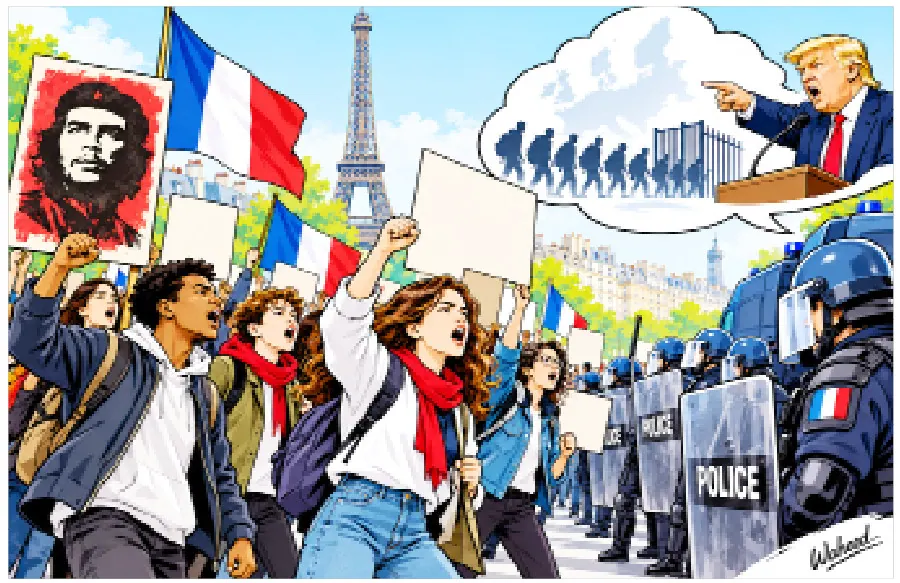
A wave of demonstrations swept through 40 French cities in early October, driven by chronic teacher shortages, dilapidated school infrastructure, overcrowded classrooms, and frustration with iron-fisted policing. The protests peaked nationally in early October, with major demonstrations concentrated in cities including Paris, Marseille, Lyon, and Rennes. University students and secondary school pupils alike took to the streets, demanding better quality human and material resources in the educational sector.
Critics and left-wing commentators drew conceptual parallels between the French protests and the historical date of Che Guevara's execution in Bolivia on October 9. Although the date is coincidental, the spirit of global youth rebellion that Che Guevara represented is deeply ingrained in French student protests. During the legendary May 1968 student uprisings in France, Che Guevara was adopted as a primary icon of anti-establishment defiance, with images frequently flying alongside red and black flags on barricades in the Latin Quarter of Paris.
The current French protests are characterised by decentralised, rapid mobilisation driven by high school student unions and amplified through digital platforms. Hundreds of thousands of secondary school and university students are on the streets, demanding systemic accountability and an end to economic austerity. The protests have resulted in clashes between students and riot police, with the police struggling to maintain order.
A comparison can be drawn between the French protests and the Nigerian student protests of the 1970s. The Nigerian student protests, which culminated in the 1978 nationwide mobilisation, were sparked by a hike in accommodation and feeding fees. The protests quickly broadened into a rejection of broader socio-economic pressures under the military regime. Despite being separated by decades and continents, both the Nigerian and French student movements expose the friction points between youth populations demanding systemic accountability and states struggling to manage economic austerity.
The French students are complaining of chronic, decade-long teacher shortages, severely overcrowded classrooms, deteriorating infrastructure, and frustration with computerised administrative admission portals. The protests have been marked by the building of blockades and clashes with riot police, evoking the ghosts of 1968 and making any proximity to revolutionary anniversaries feel rhetorically potent.
As a Nigerian, one observer felt that the French are experiencing a uniquely Francophone blend of protests rolled into one, similar to Nigeria's Ali-Must-Go and EndSARS protests. The future of every nation belongs to the youths, who are willing to put their lives on the line unconditionally in pursuit of what may appear to older folks as utopia.
The French government faces significant pressure to address the systemic issues driving the protests. With hundreds of thousands of students demanding change, the government must navigate the complexities of economic austerity and youth rebellion. The outcome of the protests remains uncertain, but one thing is clear: the French student movement is a powerful force that will not be easily silenced.
Key points
- French students protest chronic teacher shortages and poor school infrastructure.
- Protests echo the global youth rebellion spirit, drawing parallels with Che Guevara's legacy.
- French government faces pressure to address systemic issues driving the protests.