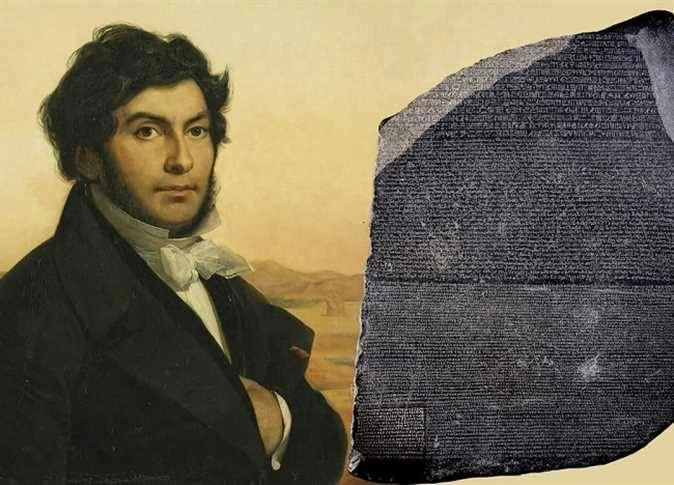
On September 27, 1822, French scholar Jean-Francois Champollion achieved a groundbreaking feat in deciphering the Rosetta Stone, unlocking the secrets of ancient Egyptian hieroglyphics. The stone, discovered in 1799 by French officer Pierre Bouchard in the Egyptian port city of Rosetta, features an inscription in three languages: hieroglyphics, demotic script, and ancient Greek. The stone's text, a decree issued in 196 BC by Egyptian priests in honor of Ptolemy V, had been a linguistic enigma until Champollion's breakthrough.
The Rosetta Stone's discovery was a significant event, as it provided a crucial link to understanding ancient Egyptian language and culture. The stone's inscriptions were written in a combination of sacred hieroglyphics, used in temples, and demotic script, the common language of the Egyptian people. Ancient Greek, the language of the ruling class, was also featured on the stone. The text was intended to be read by both the general public and the ruling elite, showcasing the achievements of the Egyptian pharaohs.
Champollion's deciphering of the Rosetta Stone was a painstaking process that involved comparing the Greek text with the hieroglyphic and demotic script inscriptions. By analyzing the relationships between the languages, Champollion was able to crack the code of hieroglyphics, a feat that had eluded scholars for centuries. His discovery opened up new avenues for understanding ancient Egyptian language, culture, and history.
The Rosetta Stone's significance extends beyond its linguistic importance, as it has provided a window into the culture and society of ancient Egypt. The stone's inscriptions offer insights into the country's history, politics, and daily life, making it an invaluable resource for historians and scholars. Today, the Rosetta Stone is housed at the British Museum, where it remains one of the most popular attractions.
Champollion's achievement on September 27, 1822, marked a major milestone in Egyptology, the study of ancient Egyptian culture and history. His work on the Rosetta Stone paved the way for future scholars to explore the language, literature, and culture of ancient Egypt. The deciphering of hieroglyphics has enabled researchers to study Egyptian texts in their original language, providing a more nuanced understanding of the country's rich history.
The impact of Champollion's discovery cannot be overstated, as it has had far-reaching implications for fields such as archaeology, anthropology, and linguistics. The study of ancient Egyptian language and culture has become a vibrant field of research, with scholars continuing to uncover new insights into the country's fascinating history. The Rosetta Stone remains an iconic symbol of Egypt's rich cultural heritage.
Today, the legacy of Champollion's achievement continues to inspire new generations of scholars and researchers. As Egyptology remains a dynamic and evolving field, the deciphering of the Rosetta Stone stands as a testament to the power of human curiosity and intellectual inquiry. The story of the Rosetta Stone serves as a reminder of the importance of preserving cultural heritage and promoting cross-cultural understanding.
Key points
- Jean-Francois Champollion deciphered the Rosetta Stone on September 27, 1822.
- The Rosetta Stone features inscriptions in three languages: hieroglyphics, demotic script, and ancient Greek.
- Champollion's discovery has had a lasting impact on the study of ancient Egyptian language and culture.