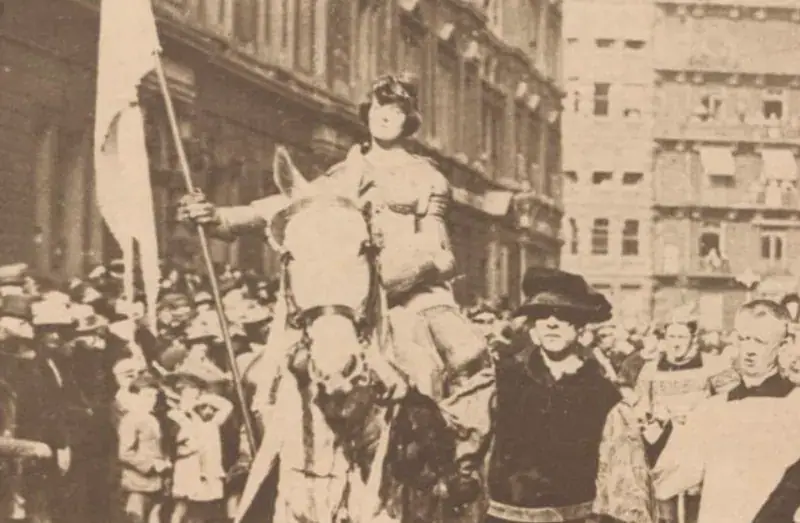
The late 19th century saw a struggle between French Catholics and Republicans over the legacy of Joan of Arc, who was on the path to sainthood. Joan of Arc, known as the Maid of Orléans, had been the subject of two trials in the Middle Ages. The first, in 1431, led to her condemnation and execution by burning at the stake. The second, in 1456, under the auspices of the King of France, resulted in her rehabilitation. Two additional trials would be required for the Catholic Church to recognize her as a blessed and a saint.
In 1894, the Catholic Church declared Joan of Arc "venerable," a necessary step toward opening a beatification trial. This move was quickly seized upon by conservative forces, who sought to use her legacy to counter the growing influence of Republican and secularist movements in France. They organized celebrations and processions in her honor, much to the dismay of Republicans, who saw Joan of Arc as a champion of the people and a symbol of their own values.
Republicans had long regarded Joan of Arc with suspicion, viewing her as a devout Catholic and a potential symbol of monarchist and clerical power. However, in the 1880s, a proposal was made to create a national holiday in her honor, with the aim of uniting Republicans and Catholic royalists. Conservative forces responded by promoting their own vision of Joan of Arc, one that emphasized her Catholic faith and loyalty to the French monarchy.
The struggle for control of Joan of Arc's legacy intensified in 1904, with the Thalamas Affair and the subsequent rupture of diplomatic relations with the Vatican. The following year, the passage of the law separating Church and State further exacerbated tensions. For Catholics, Joan of Arc's beatification and potential canonization became a means of resisting secularism and reaffirming France's Christian heritage.
When the Catholic Church officially announced Joan of Arc's beatification on April 18, 1909, the press reacted with fervor. Over 10,000 articles were published that year, a record at the time. Both sides reiterated their arguments, with conservative publications like La Gazette de France portraying Joan of Arc as a champion of Catholicism and monarchy.
The monarchist newspaper La Gazette de France dedicated its front page to Joan of Arc's beatification, invoking her as a symbol of French patriotism and Catholic devotion. The paper's edition of April 19, 1909, featured an invocation to Joan of Arc, asking her to pray for France and restore it to God and its monarchy.
Philippe, Duke of Orléans, a pretender to the French throne, wrote an article for La Gazette de France, arguing that Joan of Arc's legacy was inextricably linked to the Catholic faith and the French monarchy. He claimed that her canonization was a testament to the enduring power of these institutions and a source of hope for the restoration of the monarchy.
Key points
- The canonization of Joan of Arc was a highly politicized event in late 19th and early 20th-century France.