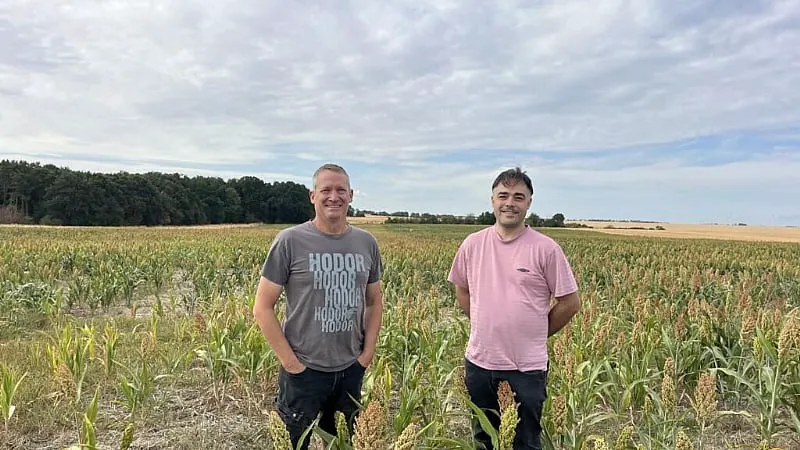
In a field in Essonne, south of Paris, a patch of green and red sorghum plants stands out among the yellow and gold squares of wheat and rapeseed. Eudes Coutté, a French sorghum grower, explained that sorghum is a plant that requires far less water than maize and thrives in hot temperatures. Sorghum is the world's fifth most important cereal crop, widely grown in sub-Saharan Africa and parts of Asia for human consumption.
Sorghum grows in hot, dry regions and thrives in temperatures of between 25C and 35C, making it an attractive option for French farmers facing repeated heatwaves. Native to sub-Saharan Africa, sorghum has steadily expanded in France over the past 15 years, with 103,000 hectares cultivated in 2024, according to the Chamber of Agriculture. Coutté started growing sorghum 10 years ago, driven by the need to adapt to climate change.
Sorghum generally requires less water than maize, and its deep root system allows it to make better use of available moisture, making it more resistant to drought. However, it is not a miracle crop, and the dry summer still affected some ears, leaving them yellowed and dried out. Coutté acknowledged that sorghum has a slightly greater capacity to resist drought but noted that successive droughts and heatwaves still had an impact.
Ludovic Joiris, who grows flax and has practised soil conservation farming for almost 20 years, partnered with Coutté three years ago to experiment with sorghum. Joiris admitted that there is still a lot to learn about growing sorghum, and the two farmers are refining their techniques. This year, Joiris faced problems with slugs eating the young plants, but areas with fewer plants performed better due to increased water availability.
Despite the potential of sorghum, expanding production is contingent on sufficient demand from consumers and livestock farmers. Franck Laborde, a maize farmer and president of the AGPM, noted that the main obstacle to growing sorghum is economic. If consumers do not support sorghum, farmers cannot afford to plant more hectares, making it challenging for sorghum to become a profitable crop.
For now, Coutté and Joiris rely on other food-related activities to supplement their farming income, as sorghum is not yet profitable enough to provide a living on its own. Their experiment highlights that adapting crops to a hotter, drier climate is only part of the challenge; farmers also need buyers willing to make those new crops economically viable.
The interest in sorghum is driven by its eco-friendly characteristics, earning it the label of 'plant of the future' from the World Wildlife Fund and the United Nations. As French farmers continue to experiment with sorghum, they face the challenge of balancing environmental benefits with economic viability, ultimately determining the crop's potential to contribute to a sustainable agricultural future.
Key points
- French farmers are experimenting with African sorghum to adapt to climate change and reduce water usage.
- Sorghum requires less water than maize and thrives in hot temperatures, making it an attractive option for French farmers.
- Expanding sorghum production in France is contingent on sufficient demand from consumers and livestock farmers.