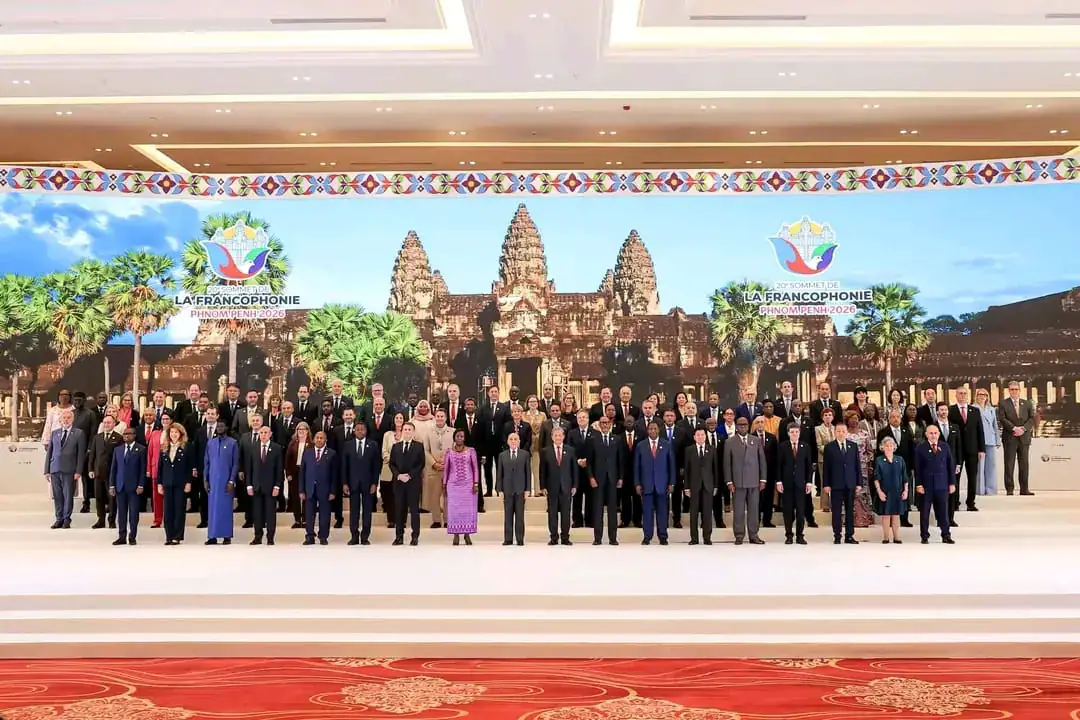
The election of the new secretary-general of the Organisation internationale de la francophonie (OIF) has been postponed by a year following a summit in Phnom Penh, Cambodia, on November 16, 2026. The decision was made due to strong tensions between the Democratic Republic of Congo (DRC) and Rwanda. The two countries have been at odds over the candidacy of Rwandan Louise Mushikiwabo, who is accused by Kinshasa of having the support of a country that backs the M23 rebels in eastern DRC.
The DRC had initially nominated Juliana Lumumba for the position but later withdrew her candidacy to support Romanian Dacian Cioloș. The DRC also threatened to leave the organization if Mushikiwabo is re-elected for a third term. According to reports, French President Emmanuel Macron personally asked Rwandan President Paul Kagame to withdraw his support for Mushikiwabo, but Kagame refused. This development has led to a possible vote by secret ballot, a first for the organization.
The tensions between the DRC and Rwanda overshadowed the summit, with both countries vying for influence within the organization. The OIF has a budget of €71.7 million for 2026, with the majority of contributions coming from a few key donors. The France, Canada, Switzerland, and the Wallonia-Brussels Federation together contribute €34.7 million, or approximately 48.4% of the organization's resources.
In contrast, the organization's African members contribute a mere €2 million, or around 2.7% of the budget. Rwanda, under Mushikiwabo's leadership, contributes €35,000 per year, a sum matched by Chad and Burundi. The United Arab Emirates and Qatar, as associate members, contribute €2.4 million, surpassing the combined contributions of all African members. Morocco is the largest African contributor, with €254,344.
This financial imbalance has significant implications for the organization's power dynamics. Canada has surpassed France as the largest contributor, while French contributions have decreased from €50 million to €30 million between 2025 and 2026. The funds from major contributors support a substantial portion of the OIF's programs and activities, giving them considerable influence within the organization.
The African continent, despite comprising the majority of OIF member states, holds limited sway within the organization due to its relatively small financial contributions. This paradox highlights the challenges faced by the OIF in balancing the interests of its diverse member states. As the organization moves forward, it will need to address these disparities to ensure a more equitable distribution of influence.
The postponed election has set the stage for further diplomatic maneuvering within the OIF. With the possibility of a secret ballot vote, the outcome remains uncertain. The organization's future will depend on its ability to navigate these complex relationships and find a balance that reflects the interests of all its member states.
Key points
- The OIF's budget for 2026 is €71.7 million, with France, Canada, Switzerland, and the Wallonia-Brussels Federation contributing 48.4% of the resources.
- African members contribute only 2.7% of the OIF's budget, with Rwanda, Chad, and Burundi each contributing €35,000 per year.
- The organization's power dynamics are influenced by the financial contributions of its member states, with Canada and France holding significant sway.
Reporting sources
- Francophonie : le torchon brûle entre la RDC et le Rwanda · Le Ndjam Post