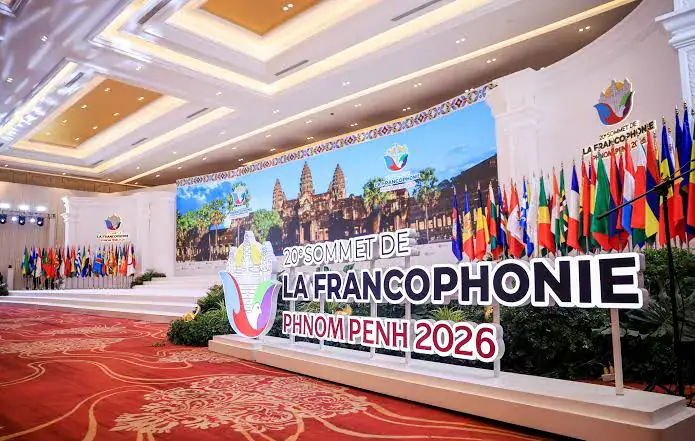
The 20th Francophonie Summit, held in Phnom Penh, Cambodia, on November 15-16, 2026, concluded with the adoption of three significant texts. The Declaration of Phnom Penh, a Resolution on crisis situations and peace consolidation, and the Phnom Penh Call for cultural heritage protection were adopted by the heads of state and government of the Francophonie. The summit, themed "Reinvesting in peace for shared prosperity and sustainable stability," marked the Francophonie's return to Southeast Asia nearly thirty years after Hanoi.
The Declaration of Phnom Penh reaffirms the support of Francophonie member states for the International Organization of La Francophonie's (OIF) actions in promoting the rule of law, mediation, and accompaniment of transitions. It emphasizes the importance of placing young people and women at the heart of peacebuilding and defending a reliable informational space against manipulation and interference. The Declaration also highlights the need to prioritize humanity in artificial intelligence and strengthen the Francophone voice in global digital governance, particularly in view of the 2027 Geneva Summit on AI.
The Resolution adopted at the summit reviews nearly twenty situations, including those in Armenia, Sudan, Haiti, the Sahel, and the Middle East. It expresses concern over border tensions between Cambodia and Thailand and the situation in eastern Democratic Republic of Congo. The Resolution also welcomes the information mission deployed by the OIF Secretary General in response to the RDC's call for solidarity from the Francophonie.
The Phnom Penh Call for cultural heritage protection encourages states and governments to better protect cultural heritage, combat illicit trafficking of cultural goods, and promote their restitution. This text aims to strengthen the protection of cultural heritage and prevent its destruction or looting. The Cambodian Prime Minister, who chaired the summit, expressed gratitude to the Cambodian people and government for their hospitality.
The summit also addressed the issue of the OIF Secretary General's mandate, which was extended by twelve months to allow for an election in 2027. Louise Mushikiwabo will continue to exercise her functions during this period, with the task of clarifying electoral rules before leaving her position. The Secretary General recalled the reforms undertaken since 2019 to make the organization more transparent, efficient, and visible.
The 21st Francophonie Summit will be held in Ottawa, Canada, preceded by a pre-summit of Francophone youth in New Brunswick. The Canadian Prime Minister, Mark Carney, has placed the next summit under the theme of the discoverability of Francophone content in the era of artificial intelligence. The Francophonie currently comprises 92 states and governments, including 53 members, 5 associate members, and 34 observers.
The Francophonie's efforts focus on promoting peace, democracy, and cultural diversity. The organization continues to play a significant role in international affairs, with a particular emphasis on the issues of artificial intelligence, cultural heritage protection, and crisis situations. The next summit in Ottawa will provide an opportunity for Francophonie member states to discuss these issues further and explore ways to strengthen their cooperation.
Key points
- The Francophonie Summit adopted three key texts focusing on peace, crisis situations, and cultural heritage protection.
- The OIF Secretary General's mandate was extended by twelve months to allow for an election in 2027.
- The 21st Francophonie Summit will be held in Ottawa, Canada, with a focus on the discoverability of Francophone content in the era of artificial intelligence.