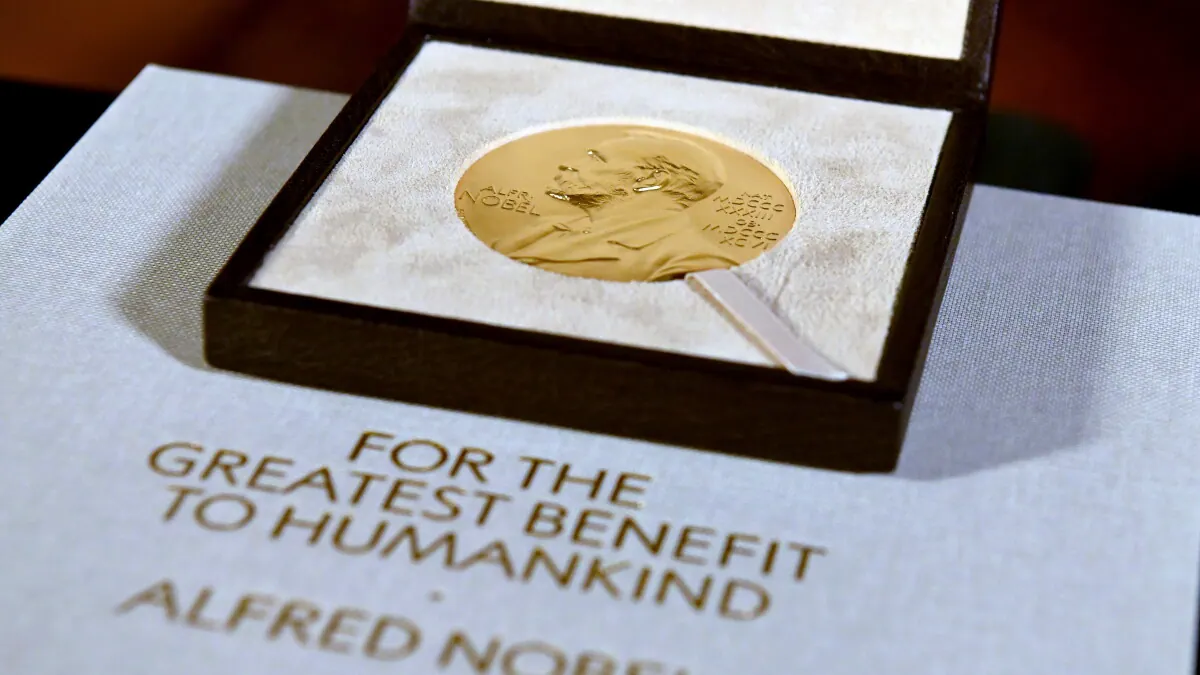
Francis Halzen, an 82-year-old scientist affiliated with the University of Wisconsin–Madison, has been awarded the Nobel Prize in physics for his contributions to the IceCube Neutrino Observatory and the discovery of high-energy neutrinos of astrophysical origin. The Royal Swedish Academy of Sciences announced the award in Stockholm. Halzen, born in Belgium, led an international team of researchers and engineers in developing the observatory. His work has paved the way for a new kind of astronomy. The University of Wisconsin–Madison is the lead institution for the IceCube Neutrino Observatory.
The IceCube Neutrino Observatory, located at the South Pole in Antarctica, is a research facility that has enabled scientists to study high-energy neutrinos from space. Halzen's research into capturing neutrinos at the South Pole dates back to the 1980s. Neutrinos are tiny cosmic particles that are everywhere, but scientists can't glimpse them on their own. Instead, they measure what happens when the particles collide with other bits of matter, producing flashes of light or charged particles. This has provided clues to how the universe evolved.
Halzen's discovery of high-energy neutrinos of astrophysical origin has been hailed as a significant breakthrough. The Nobel Committee for Physics chair, Mark Pearce, praised Halzen's tenacity and scientific vision, saying he has provided the scientific community with a fantastic instrument. Halzen spoke to the committee by phone from Italy, saying he was surprised by the award, despite having predicted it before. The prize money for this year's award is 12 million Swedish kronor, approximately $1.2 million.
The IceCube Neutrino Observatory has been a collaborative effort, with an international team of researchers and engineers working together to develop the facility. The observatory has enabled scientists to study rare gang of neutrinos that are considered messengers from the cosmos. These particles offer insights into the universe's evolution and have the potential to reveal more about the mysteries of the cosmos.
This year's Nobel Prizes have seen a series of awards announced, starting with the Nobel Prize in medicine being awarded to three scientists whose work led to a tool that uses light to help unravel how the brain works. The physics prize is one of several awards to be announced this week, with the chemistry prize and literature prize to follow. The Nobel Memorial Prize in Economic Sciences will be announced on Monday.
The Nobel Prize in physics is one of the most prestigious awards in the scientific community, recognizing outstanding contributions to the field. Last year, three scientists won the Nobel Prize in physics for research on the strange behavior of subatomic particles called quantum tunneling. This year's award to Halzen recognizes his groundbreaking work on high-energy neutrinos from space.
Halzen's award is a testament to his dedication to scientific research and his contributions to our understanding of the universe. His work on high-energy neutrinos has opened up new avenues for scientific exploration and has the potential to lead to further breakthroughs in the field. The Nobel Prize in physics is a fitting recognition of his achievements.
Key points
- Francis Halzen wins Nobel Prize in physics for work on high-energy neutrinos from space.
- The IceCube Neutrino Observatory, located at the South Pole in Antarctica, is a research facility that has enabled scientists to study high-energy neutrinos from space.
- The Nobel Prize in physics recognizes outstanding contributions to the field, and Halzen's award is a testament to his dedication to scientific research.