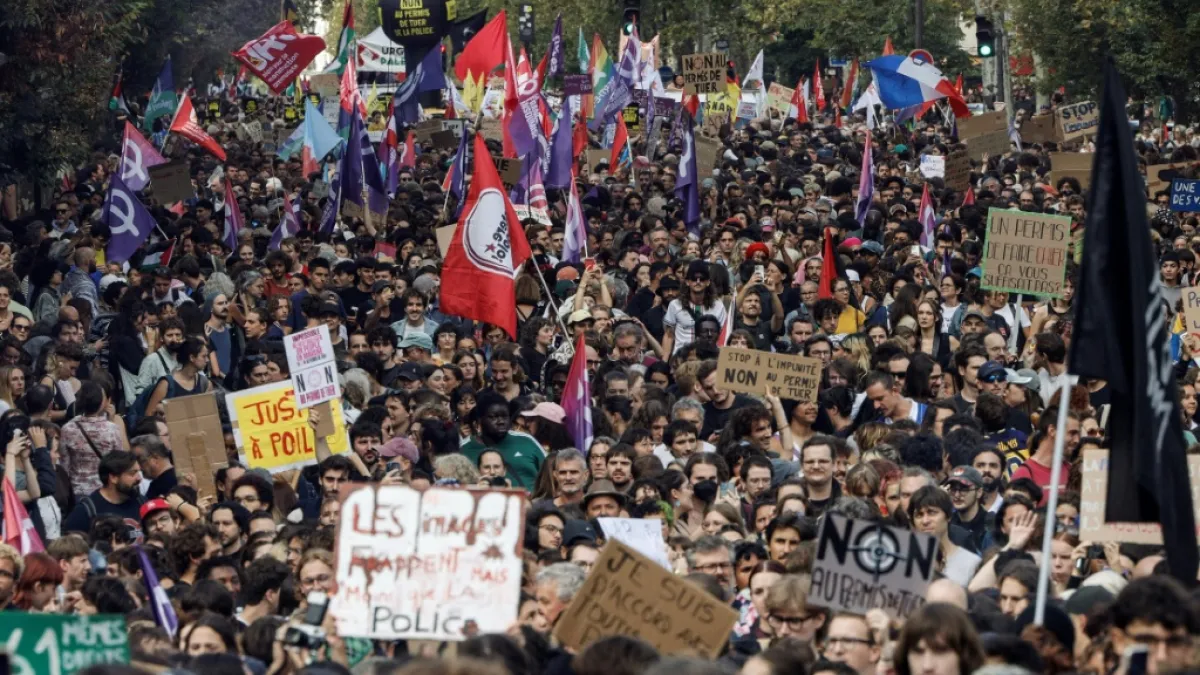
Tens of thousands of people took to the streets in France on Sunday to protest against a proposed law that would change the way police use of weapons is investigated. The law, which was approved by the National Assembly on July 7, presumes that police officers have acted legally when using their weapons, unless proven otherwise. This has sparked concerns among human rights groups and left-wing parties that it could lead to a "license to kill" for police officers.
The protests were organized by several groups, including Amnesty International, the League of Human Rights, and left-wing parties, as well as the union of judges. In Paris, a crowd of 21,000 people marched through the streets, according to police estimates. Protesters carried signs that read "Our lives are worth living, not dying - No to a license to kill!" and "More power = more abuses." The demonstrations were largely peaceful, but there were reports of clashes between police and protesters.
In Paris, police fired tear gas briefly before the evening, and a journalist from AFP reported seeing a person injured in the head. The proposed law has sparked a heated debate in France, with supporters arguing that it would protect police officers from automatic suspicion and detention. However, opponents argue that it would make it more difficult to investigate police use of weapons and could lead to a lack of accountability.
The law would require prosecutors to prove that police officers acted illegally when using their weapons, rather than the other way around. This has raised concerns that it could lead to a decrease in investigations into police use of force and a lack of transparency. The protests on Sunday were a show of force against the proposed law, with demonstrators calling for it to be scrapped.
The issue has sparked a wider debate about police brutality and accountability in France. In recent years, there have been several high-profile cases of police use of force that have sparked widespread outrage and calls for reform. The proposed law has been seen as a step in the wrong direction by many, who argue that it would only serve to further erode trust between police and the public.
The French government has defended the proposed law, arguing that it is necessary to protect police officers from unfair scrutiny. However, opponents argue that it would only serve to further militarize the police and increase the risk of human rights abuses. The protests on Sunday were a clear indication that there is significant opposition to the law, and it remains to be seen how the government will respond to the backlash.
The outcome of the proposed law is uncertain, but one thing is clear: it has sparked a national conversation about police accountability and human rights in France. As the debate continues, it remains to be seen how the government will balance the need to protect police officers with the need to ensure that they are held accountable for their actions.
Key points
- The proposed law would presume that police use of weapons is legal, unless proven otherwise.
- The protests were organized by human rights groups, left-wing parties, and the union of judges.
- The law has sparked concerns of a "license to kill" for police officers and could lead to a decrease in investigations into police use of force.