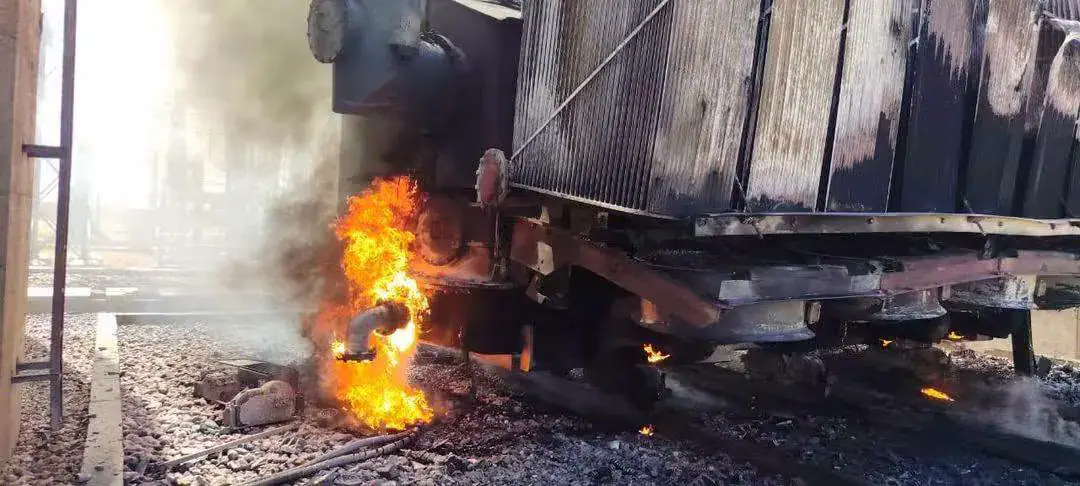
Residents of El Dueim in White Nile state are counting the economic and social costs of a four-day electricity blackout following a drone attack on the Mashkour substation on 26 October. The outage disrupted hospital services, paralysed workshops, and small businesses, and forced daily-wage workers to borrow money to meet their families’ basic needs.
The restoration of electricity to El Dueim in White Nile state has not been enough to erase the impact of four consecutive days without power. The outage placed additional operational burdens on healthcare institutions, caused financial losses for workshop owners and small businesses, and left workers dependent on daily earnings accumulating debts to support their families.
According to residents, the city is now operating under a system that alternates electricity supplies between two networks, eastern and western. Under the schedule, one network is disconnected for eight hours, from 06:00 to 14:00, while the other continues receiving electricity. The following day, the arrangement is reversed.
During the four-day blackout, El Dueim Hospital’s administration was forced to rely on generators to maintain surgical operations and provide lighting. An employee at the hospital told Radio Dabanga that the hospital had to operate its generator to provide electricity for surgical procedures and lighting during the night, adding considerably to the hospital’s operating costs.
In contrast to the difficulties faced by El Dueim Hospital, the city’s dialysis centre managed to maintain its services throughout the blackout, relying on a solar power system that provided a stable alternative to the public electricity supply. A female employee at the centre told Radio Dabanga that staff and patients had previously struggled whenever electricity was interrupted.
The blackout brought workshop activities to a standstill in the industrial area and El Dueim market. Haroun Mohamed Ali, who owns a furniture-making workshop, told Radio Dabanga that the power cuts had compounded the difficulties facing workshop owners, who were already struggling with harsh economic conditions.
Although the restoration of electricity has ended the continuous blackout, its economic and social consequences remain. El Dueim continues to depend on scheduled electricity distribution and rotating power cuts to supply its different neighbourhoods.
Key points
- A drone attack on the Mashkour substation caused the four-day electricity blackout in El Dueim, White Nile state.
- The blackout disrupted hospital services, paralysed workshops, and small businesses, and forced daily-wage workers to borrow money to meet their families’ basic needs.
- El Dueim now operates under a system that alternates electricity supplies between two networks, eastern and western.