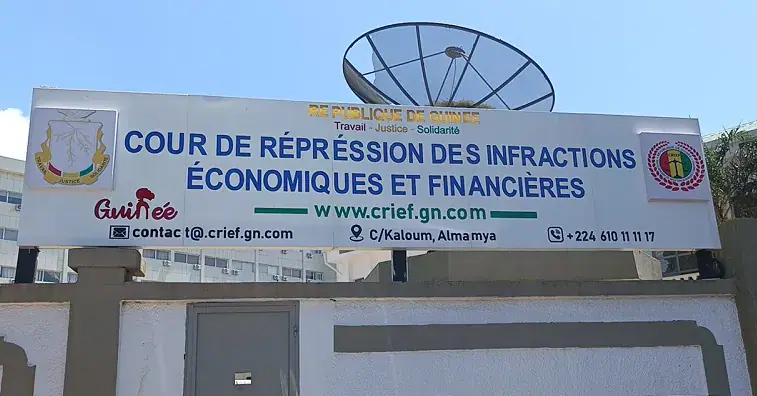
Four people, Thierno Hamidou Komah, Alphadjo Komah, Sana Komah, and Mamadou Mansaré, appeared before Guinea's CRIEF court on November 24, 2026, to face charges related to alleged illegal gold mining in the agricultural area of Damantan, Mamou prefecture. The four are accused of corruption, severe environmental damage, and other offenses. The case was brought to court following a complaint by local leaders, Mamadou Kanan Mansaré and Djéli Diallo.
The accused individuals denied the allegations against them. Thierno Hamidou Komah stated that he is a farmer and does not engage in gold mining, claiming that his land was allocated to others while he was away receiving medical treatment in Conakry. Alphadjo Komah also denied the allegations, stating that he had lent his land for agricultural purposes and was not involved in gold mining. Sana Komah and Mamadou Mansaré similarly denied any involvement in gold mining.
However, the complainants, Mamadou Kanan Mansaré and Djéli Diallo, provided a different account. Mamadou Kanan Mansaré stated that the site in question was allocated for agricultural purposes, but gold mining activities were discovered on the land. He claimed that when a mission was sent to the site, they were threatened by a military personnel and that the accused individuals were involved in the gold mining activities.
Djéli Diallo, the village elder, pointed to Thierno Hamidou Komah as the main person responsible for the alleged illegal gold mining. He stated that the government had provided a tractor for agricultural activities and that the land in question belonged to the state. Diallo claimed that when a mission was sent to the site, they found people mining gold and were threatened by a military personnel.
The court ordered a judicial inspection of the Damantan site, which is set to take place on December 11, 2026. The trial is scheduled to continue on January 12, 2027. The accused individuals are not in detention. The case has raised concerns about the environmental and social impacts of illegal gold mining in Guinea.
According to local leaders, multiple sites in the area are currently being exploited for gold, affecting the environment and local communities. The complainants claim to have video evidence showing one of the accused individuals accompanied by a military personnel, instructing mission members to leave the site.
The trial's outcome will be closely watched, as it highlights the challenges of regulating artisanal and small-scale gold mining in Guinea. The court's decision will likely have implications for the country's efforts to balance economic development with environmental protection and social responsibility.
Key points
- The four accused individuals face charges of corruption and environmental damage related to alleged illegal gold mining in a Guinea agricultural area.
- The court ordered a judicial inspection of the site, set to take place on December 11, 2026.
- The trial's outcome will have implications for Guinea's efforts to regulate artisanal and small-scale gold mining.