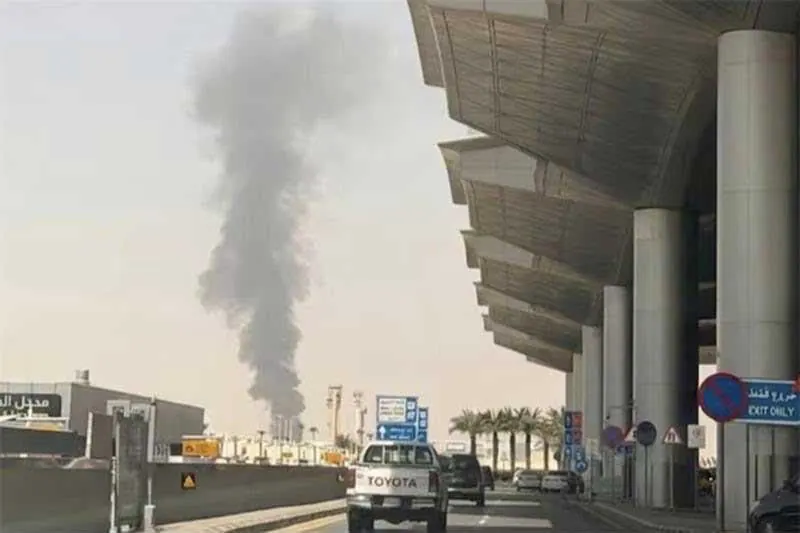
The Houthi group in Yemen has launched a series of attacks against Saudi Arabia, targeting oil installations, air bases, and the capital city of Riyadh. The attacks, which began in July, have involved ballistic missiles, cruise missiles, and drones. On July 13, the Houthis struck the Abha Airport in southern Saudi Arabia, and on July 22, they targeted two Saudi vessels, the Encelia and the Layla. The attacks have continued into September, with deep-strike salvos targeting Aramco facilities and air bases.
The Houthi strategy prioritizes operations based on rapidly available capabilities, leveraging their positioning along Yemen's western coastline and key offshore islands. The group has focused on employing combined attacks using ballistic missiles, cruise missiles, and drones. The objective is to overwhelm and distract air-defense systems and aerial formations. The Houthis have targeted oil refineries and critical energy infrastructure to cause economic disruption. Their attacks have included strikes on Aramco facilities in Abha, Najran, and Jizan City.
The Saudi military has responded to the attacks by procuring advanced defense systems. In July, they acquired the Advanced Precision Kill Weapon System (APKWS II), which has proven effective at intercepting one-way attack drones. In September, they secured a deal for 10,000 Joint Direct Attack Munition-Extended Range (JDAM-ER) kits, which convert standard unguided bombs into high-precision standoff munitions. These systems enable Saudi F-15 and Eurofighter Typhoon platforms to strike deep into Houthi territory.
The Houthis rely on a decentralized air-defense doctrine, utilizing short- to medium-range systems with hybrid guidance mechanisms. However, these systems lack networked integration, limiting them to executing localized air-defense ambushes. The integration of JDAM-ER munitions neutralizes this threat vector by providing Saudi pilots with the standoff range required to destroy targets from beyond the effective envelope of these decentralized systems.
The Houthi attacks have continued to target oil installations, forward air bases, and the capital city of Riyadh. The group's military options are driving them to persist with this tripartite targeting model, which represents their most effective vector for exerting operational and strategic pressure. The Saudi military, along with air-defense networks, will continue enhancing interception efficiency and balancing defensive operations with proactive airstrikes against Houthi weapons systems and ammunition depots.
The conflict has highlighted the importance of air superiority in the region. The Royal Saudi Air Force (RSAF) has demonstrated its capacity to adapt and maintain air superiority over Yemeni airspace, enabling it to deliver heavy and precise strikes. The RSAF, along with Saudi air-defense networks, will continue to play a crucial role in countering Houthi attacks.
The Houthi attacks have significant implications for regional security and stability. The conflict is likely to continue, with both sides seeking to exert pressure on the other. A political solution will be necessary to alleviate the strain on home-country air defenses and bring an end to the conflict. The Egyptian Centre for Strategic Studies has been monitoring the situation closely, and experts are analyzing the implications of the conflict for regional security.
Key points
- The Houthi group's attacks on Saudi Arabia have targeted oil installations, air bases, and the capital city of Riyadh.
- The Saudi military has responded by procuring advanced defense systems, including the APKWS II and JDAM-ER kits.
- The conflict is likely to continue, with both sides seeking to exert pressure on the other, until a political solution is reached.