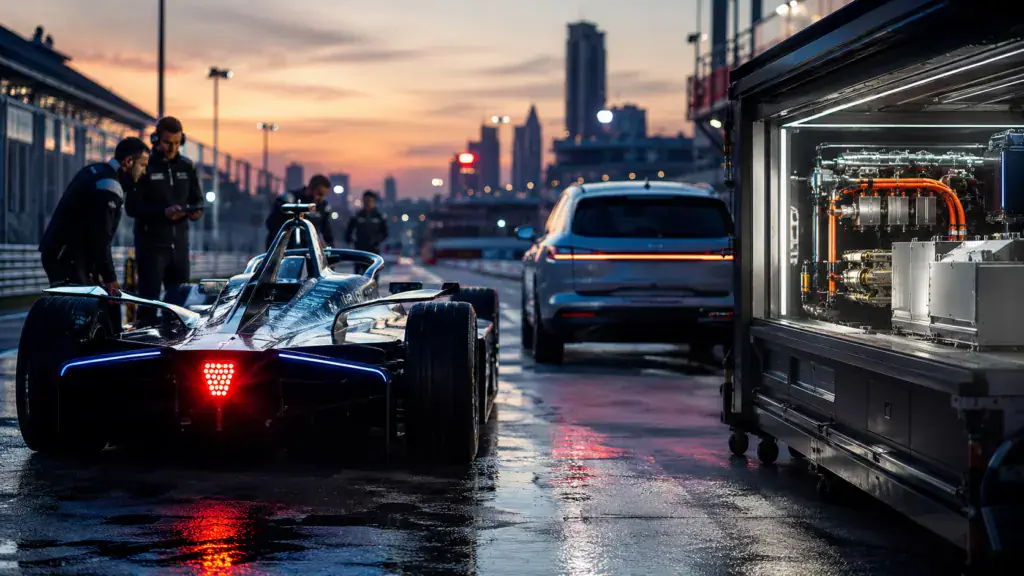
The Formula E championship recently concluded its 2025-2026 season in London, marking the end of the GEN3 era. The championship saw 17 rounds, with Porsche's Pascal Wehrlein securing his second world driver title. The GEN3 era is being replaced by the GEN4, which is expected to make its debut in the 2026-2027 season. The GEN4 will feature significant upgrades, including increased power and efficiency.
The GEN3, which is coming to the end of its cycle, boasts impressive performance capabilities, including the ability to accelerate from 0 to 60 mph in 1.82 seconds and recover up to 600 kW through regenerative braking. According to Formula E, the vehicle can recover over 40% of the energy used during a race. The GEN3 also features integral transmission available during qualifying duels, starts, and ATTACK MODE.
Porsche is applying the lessons learned from Formula E to its production vehicles, including the Taycan. The company indicates that energy recovery can provide around 45-55% of the energy needed during a Formula E race. The Taycan can recover up to 400 kW, and Porsche states that around 90% of daily braking can be managed electrically without activating the hydraulic wheel brakes.
Jaguar has also transferred its experience from the track to road development, citing the example of its Type 01 electric GT. The company has highlighted the benefits of its all-wheel-drive control software and fast-switching inverters powered by silicon carbide components. Jaguar has also emphasized the contribution of competition in areas such as regenerative braking, autonomy, and fast charging.
The connection between Formula E and production vehicles is not limited to powertrain technology. The championship also provides a platform for testing and developing software that can be applied to production vehicles. Nissan, for example, views Formula E as part of its broader electrification research and development activities. The company sees the software developed for Formula E as a key component in shaping future intelligent energy solutions for production electric vehicles.
The upcoming GEN4 era will push the boundaries of engineering even further. The GEN4 will feature 450 kW of power in race mode, 600 kW in ATTACK MODE, and up to 700 kW of regenerative braking. The vehicle will also have permanent all-wheel drive and up to 55 kWh of usable energy during a race. The GEN4 is expected to reach speeds of over 335 km/h and accelerate from 0 to 200 km/h in 4.4 seconds.
As the GEN4 era approaches, manufacturers such as Porsche, Nissan, Jaguar, Stellantis, Lola Cars, and Mahindra are preparing to develop these technologies over the next four seasons, until 2030. The software will play a central role in this development, as it determines the balance between performance and efficiency. The experience gained from Formula E will likely have a significant impact on the development of next-generation electric vehicles.
Key points
- The GEN4 era will feature significant upgrades, including increased power and efficiency.
- Manufacturers are applying lessons learned from Formula E to production vehicles, including energy recovery and software development.
- The connection between Formula E and production vehicles is not limited to powertrain technology, but also includes software development and testing.