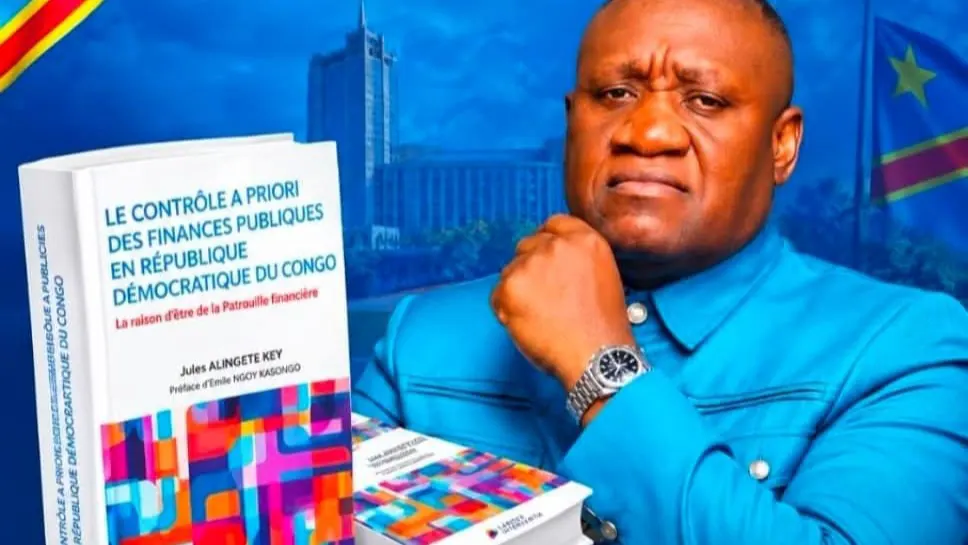
In Paris, Jules Alingete Key, the former head of the Inspection General of Finance (IGF) in the Democratic Republic of Congo, has presented his book on preventive financial control. The book, titled "Le contrôle a priori des finances publiques en République démocratique du Congo : la raison d'être de la Patrouille financière", outlines his experience in controlling public finances and details his "financial patrol" approach. Alingete's book aims to share his expertise and experience in preventing financial irregularities.
Alingete, who led the IGF for five years, has spent nearly four decades working in the institution. His book is a practical guide that demonstrates how to prevent fraud and embezzlement. The "financial patrol" approach involves intervening before financial operations are executed, rather than after irregularities are detected. This approach, Alingete explains, is based on the Congolese legislation, which already provides for several forms of financial control, including a priori, concomitant, and a posteriori.
The "financial patrol" approach was inspired by police methods, where patrols are conducted in sensitive areas to prevent crimes. Alingete transposed this logic to the financial domain, examining financial operations before they are executed to identify risks and prevent losses. This approach was a hallmark of his tenure at the IGF, where he significantly increased the institution's visibility in the public debate on financial governance.
During his tenure, the IGF conducted numerous investigations and control missions, particularly in the areas of public enterprises, provinces, public markets, and state revenues. A 2024 report showed a significant increase in IGF investigations, from less than a dozen to several dozen per year. The "financial patrol" approach was also extended to the management of certain provinces.
Alingete attributes the growth in the DRC's public revenues to the strengthened financial control. He claims that the country's own resources increased from approximately $4 billion in 2020 to $12 billion in 2025, with a projected budget of $24 billion for 2027. Alingete credits this growth to the combined efforts of various stakeholders, including the IGF.
The book presentation took place at the Maison Congo in Paris, attended by scientific authorities, diplomats, public finance officials from across Africa, and the diaspora. Alingete emphasized that his approach is not a personal invention, but rather a doctrine based on Congolese legislation and his experience at the IGF.
The former IGF head aims to leave a lasting legacy with his book, which provides a theoretical, pedagogical, and practical framework for preventive financial control. Alingete hopes that his work will contribute to the development of a culture of transparency and accountability in public financial management in the DRC and beyond.
Key points
- The book outlines Alingete's "financial patrol" approach, which involves preventive financial control to prevent irregularities and losses.
- The approach was inspired by police methods and has been credited with increasing public revenues in the DRC.
- Alingete's book aims to share his expertise and experience in preventing financial irregularities and promoting transparency and accountability in public financial management.