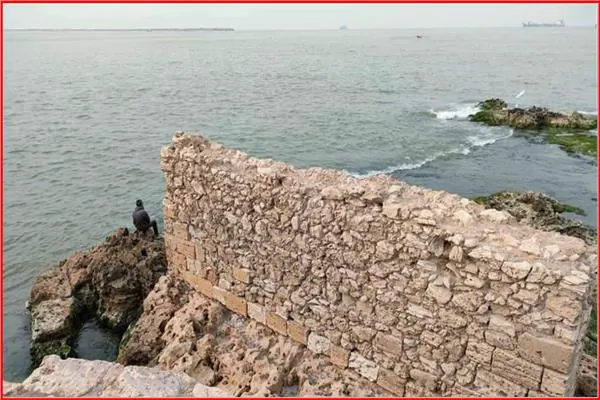
For centuries, the city of Alexandria has stood as a testament to resilience and strategic prowess. Its prime location on the Mediterranean coast made it a crucial point of defense against invaders. The city's rich history is reflected in its numerous fortresses and towers, such as Kosa Pasha, Am Qubiba, Al-Dokheila, and Al-Nahasheen, which once formed a robust defensive system. These structures, built across various eras, showcase the evolution of military architecture and the city's significance in history.
According to Dr. Islam Assem, a former tour guide supervisor in Alexandria and a professor of modern and contemporary history, the defensive system in Alexandria evolved over time, particularly during the Mamluk and Ottoman periods, as well as under the rule of Muhammad Ali Pasha. One of the most notable fortifications is the Qaitbay Citadel, built between 1477 and 1479 AD by Sultan Al-Ashraf Qaitbay on the site of the ancient Alexandria Lighthouse. This citadel was a crucial part of the city's defense system.
As military technology and artillery advanced, the defensive structures of Alexandria underwent significant changes. During the French campaign in Egypt, new defensive installations were added to the city's fortifications, including artillery forts like the Fort of Kom El-Nagoura, which still stands today. Under Muhammad Ali's rule, a comprehensive effort was made to modernize Alexandria's defensive system. By 1848, the number of fortresses and towers had increased to 25, as documented by Hassan Pasha Al-Iskandirani, the Minister of the Navy.
Dr. Assem highlights that some of the most notable towers include the Al-Nahasheen tower in the Shatalat area, which was part of the defensive lines established in front of the old city walls in the mid-19th century. The Kosa Pasha tower in Abu Qir, east of Alexandria, is a prime example of 19th-century military fortifications. Located on a hill, it was surrounded by inner and outer walls and a moat. In contrast, the Al-Dokheila tower in the west of the city presented another aspect of the coastal defense system.
The bombardment of Alexandria in 1882 marked a significant turning point in the city's military history, leading to the decline of its fortresses. Dr. Assem proposes a project to develop these historical towers, transforming each into a museum that narrates a specific phase or aspect of Alexandria's military history. The proposed project includes the restoration and qualification of several towers, including Yusr, Am Qubiba, Al-Nahasheen, Bab Rashid, Kosa Pasha, and Al-Dokheila.
The project aims to remove encroachments around these historical sites, create a unified heritage path, and introduce digital display means and informational panels. Some internal spaces could be repurposed for cultural activities, preserving their historical value while converting these scattered military remnants into an integrated heritage and tourist network. This initiative would rediscover Alexandria as a city of fortifications and coastal defense.
In a recent move to revive Alexandria's neglected fortresses, Alexandria Governor, Ayman Attia, held a meeting to discuss the rehabilitation and upgrading of the Kosa Pasha tower in Abu Qir. The goal is to include it in the city's tourist and heritage destinations, acknowledging its historical significance and potential for cultural and economic development. The Kosa Pasha tower, dating back to Muhammad Ali Pasha's era, is a testament to the city's rich history and its strategic importance during that period.
Key points
- The proposed project aims to restore and develop several historical towers in Alexandria, including Kosa Pasha, Am Qubiba, and Al-Nahasheen.
- The project seeks to create a unified heritage path and introduce digital display means and informational panels to highlight the historical significance of these structures.
- The rehabilitation of the Kosa Pasha tower in Abu Qir is part of a broader effort to include historical sites in Alexandria within the city's tourist and heritage destinations.