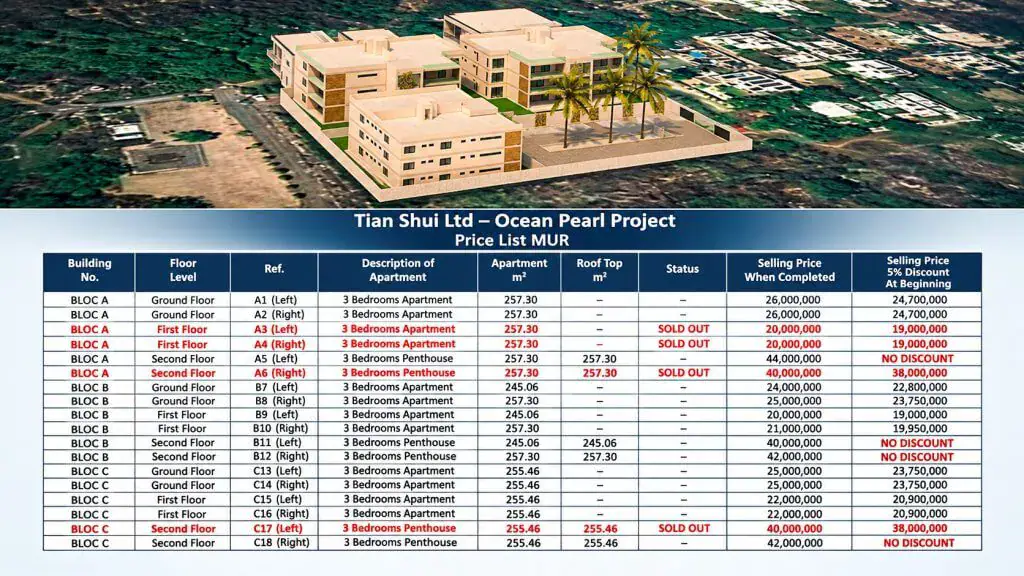
A recent development in Tamarin, Mauritius, has raised concerns about foreign speculation in the country's real estate market. Zhang Hongyun, a Chinese national who obtained Mauritian nationality in 2016, acquired a 3,834 square meter plot of land in Tamarin for Rs 37 million in July 2025. This was made possible through a loan from a local bank, with the land serving as security. Zhang Hongyun is the chairman of the China Shanxi Tianli Enterprise Group, which has been involved in various business ventures in Mauritius.
Zhang Hongyun's company, Tian Shui Ltd, was registered on August 27, 2024, just three months before the change in government. The company's primary activity is listed as the development of building projects for sale, with its address being Tianli Spinning (Mauritius) Co. Ltd. Zhang Hongyun is the sole shareholder, having injected Rs 1 million as capital. However, Tian Shui Ltd has not submitted any financial statements to the Registrar of Companies since its inception.
Tian Shui Ltd is involved in a high-end residential project called Ocean Pearl, which is being constructed on the acquired land in Tamarin. The project consists of 18 apartments, priced between Rs 26 million and Rs 44 million, which will be sold to foreigners. The total construction cost is estimated to be around Rs 200 million, while the projected revenue from the sale of the apartments is Rs 524 million, resulting in a significant profit of over Rs 300 million.
The acquisition of the land and the construction of the Ocean Pearl project were facilitated by Yu Fei Zhang, a 24-year-old Canadian of Chinese origin. Neighbors of the project had objected to its construction, citing concerns about the project's size, which blocks their view and sunlight, as well as the potential disturbance caused by the pool and windows. Despite their objections, the project was approved by the Rivière-Noire district council on February 26, 2026.
The case has been taken to the Supreme Court, and it raises questions about the current laws and regulations governing foreign investment in Mauritius' real estate sector. The increasing number of high-rise residential projects in the country has sparked concerns about the impact on local residents and the environment. The Mauritian government has been criticized for its policies, which seem to favor foreign investors over local citizens.
The Ocean Pearl project is not an isolated case, as there are numerous other high-end residential projects being developed in Mauritius, primarily targeting foreign buyers. These projects often involve foreign investors obtaining Mauritian nationality, acquiring land, and selling apartments to other foreigners. This has led to concerns about the concentration of wealth and the impact on the local economy.
The issue highlights the need for the Mauritian authorities to review and amend the existing laws and regulations governing foreign investment in the real estate sector. This includes ensuring that the interests of local residents are protected and that the development of high-end residential projects aligns with the country's economic and social objectives. The government must balance the need for foreign investment with the need to safeguard the interests of its citizens.
Key points
- Foreign investors are obtaining Mauritian nationality and acquiring land to develop high-end residential projects, primarily targeting foreign buyers.
- The projects have sparked concerns about the impact on local residents, the environment, and the concentration of wealth.
- The Mauritian government needs to review and amend the existing laws and regulations governing foreign investment in the real estate sector.