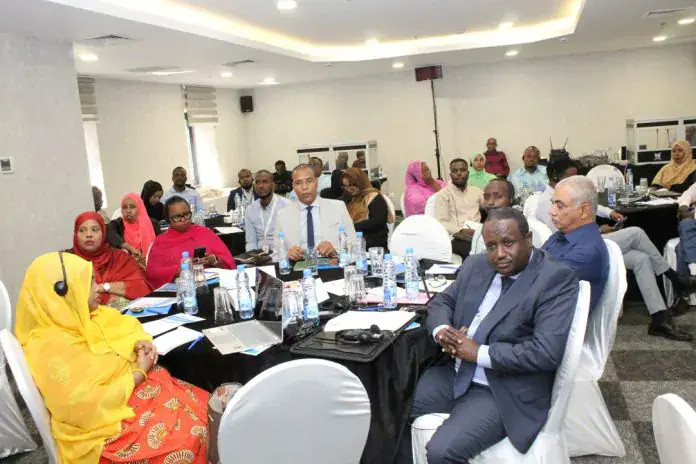
The government of Djibouti has launched a micro-Takaful project aimed at providing financial protection to small businesses and young entrepreneurs. The project combines Islamic finance and risk coverage to help small enterprises overcome financial difficulties and increase their resilience. The initiative was validated by institutional and financial actors in the sector at a recent workshop held at the Best Western Hotel.
The micro-Takaful project addresses the challenges faced by small businesses in accessing finance and managing risks. According to the 2023 data, only 34% of the population in Djibouti has access to formal financial services. The project aims to bridge this gap by providing an innovative solution based on solidarity and risk-sharing principles. The UNDP's resident representative in Djibouti, Philippe Clerc, emphasized that financial inclusion is not just about providing access to finance, but also about enabling individuals to protect their businesses and overcome risks.
A study conducted by the Central Bank of Djibouti, in partnership with the UNDP and the Ministry of Economy, Finance, and Industry (MEFI), found that small businesses face significant obstacles in accessing finance and managing risks. The study surveyed 70 enterprises and found that only 11% had obtained bank financing in the past year. Moreover, over 50% of respondents cited guarantee requirements as a major constraint to accessing credit, with women-led enterprises being disproportionately affected.
The study also highlighted the vulnerability of small businesses to various shocks, including price fluctuations, payment delays, health issues, equipment deterioration, and climate-related risks. Nearly 50% of enterprises reported reducing their activity after suffering a significant loss. The study's findings confirm the need for a new approach to supporting small businesses, one that combines financial access with risk protection.
The micro-Takaful project has garnered significant interest from small businesses, with over 71% of surveyed enterprises expressing support for a product that combines Islamic finance and Takaful protection. Additionally, over 81% of respondents emphasized the importance of ensuring that financial products comply with Sharia principles. The project's success will depend on the coordination between the Central Bank of Djibouti and the MEFI, particularly in defining the regulatory and operational modalities.
The launch of the micro-Takaful project marks a significant step towards promoting financial inclusion and supporting small businesses in Djibouti. According to Abdirahman Robleh Bouraleh, director of monetary statistics and balance of payments at the Central Bank of Djibouti, financial inclusion is crucial for economic development, and it requires more than just facilitating access to credit. The project is expected to contribute to the growth of Islamic finance in Djibouti, which currently accounts for 32% of the country's banking assets.
The project's implementation will require adaptations to the existing regulatory framework, particularly in areas such as micro-insurance, Sharia governance, and supervision. The Central Bank of Djibouti and the MEFI will need to work together to ensure the project's success and to define the necessary regulatory and operational modalities. The project's outcome will be closely monitored, and its success could pave the way for similar initiatives in the region.
Key points
- The micro-Takaful project aims to provide financial protection to small businesses and young entrepreneurs in Djibouti.
- The project combines Islamic finance and risk coverage to help small enterprises overcome financial difficulties.
- The initiative is expected to contribute to the growth of Islamic finance in Djibouti, which currently accounts for 32% of the country's banking assets.