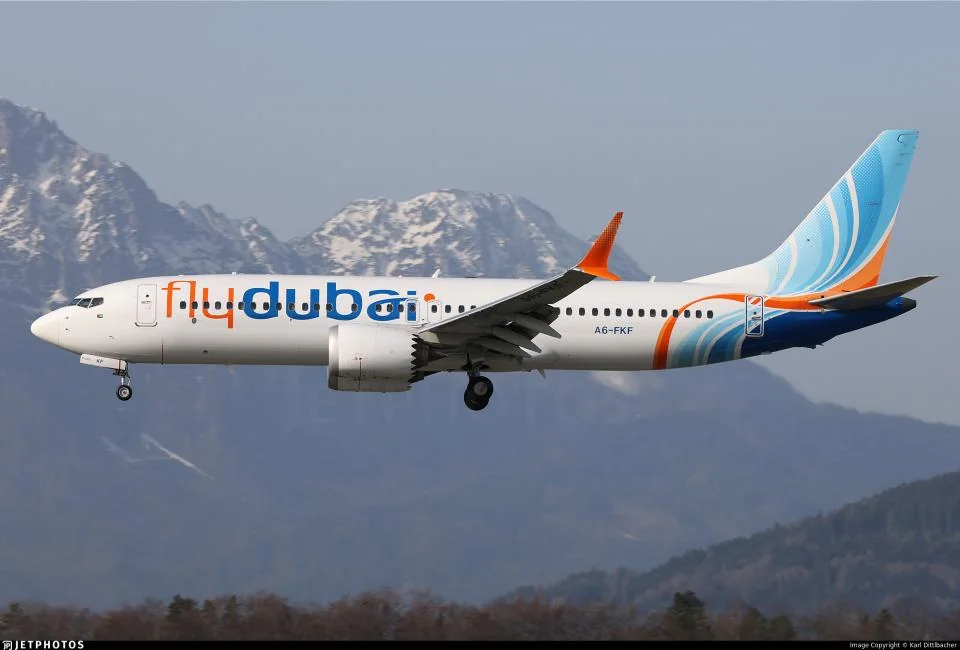
A Flydubai flight from Dubai to Tel Aviv was forced to divert to Saudi Arabia after a physical confrontation between the pilots on board. The incident occurred on Wednesday, and the aircraft, a Boeing 737 MAX 8, was heading to Ben Gurion Airport when it began sending emergency transponder codes. Flight FZ1073 later changed course and headed towards Saudi Arabia before landing safely at Tabuk Airport. All passengers on board were reported safe and accounted for.
According to flight-tracking data, the aircraft first transmitted code 7700 at about 05:31 UTC, indicating a general emergency. About seven minutes later, the aircraft's transponder switched to code 7500, which is used internationally to indicate unlawful interference or a suspected hijacking. The aircraft later returned to code 7700 before changing course towards Tabuk. The 7500 transmission prompted a security response in Israel, with reports indicating that Israeli fighter jets were scrambled after authorities considered the possibility that the aircraft had been taken over.
The situation was later clarified, with subsequent reports indicating that the incident was not a hijacking. Reuters reported that an Israeli official said the two pilots had physically fought while the plane was in the air. The Israeli prime minister's office also confirmed that the incident was not a hijacking. Authorities were left investigating what caused the confrontation and how it resulted in the emergency signals and the aircraft's sudden change in altitude.
Israeli Prime Minister Benjamin Netanyahu held security consultations with defence officials as authorities sought to establish the nature of the emergency. The seriousness of the situation was highlighted by flight-tracking data showing a rapid descent during the flight. According to Flightradar24, the aircraft dropped from 30,875 feet to 16,750 feet, a drop of 14,125 feet in just 29 seconds. The aircraft later stabilised and was diverted towards Tabuk, where it landed safely.
Earlier reports had suggested that one of the pilots may have deliberately pushed the aircraft into a steep descent in what appeared to be an attempt to crash it, before the other pilot intervened and managed to regain control. Israeli journalists reported that authorities were examining the circumstances surrounding the cockpit confrontation. There were also reports that 174 passengers were travelling on the aircraft.
The use of the 7500 transponder code added to the concern because it is one of the internationally recognised signals used by flight crews to alert air traffic controllers to unlawful interference. A transmission of the code is treated as a serious security matter while authorities work to determine why it was activated. The incident occurred as the aircraft was travelling between the United Arab Emirates and Israel, two countries that established diplomatic relations in 2020 under the Abraham Accords.
Flydubai said its teams were working with the relevant authorities to establish what happened during the flight. The airline also confirmed that all passengers were safe and accounted for. Further investigations are expected to establish the events that led to the pilots' confrontation, the emergency signals, and the aircraft's rapid loss of altitude.
Key points
- The incident highlights the importance of aviation safety and the protocols in place to respond to emergency situations.
- The use of emergency transponder codes 7700 and 7500 added to the concern and prompted a security response in Israel.
- The aircraft landed safely at Tabuk Airport, and all passengers were reported safe and accounted for.