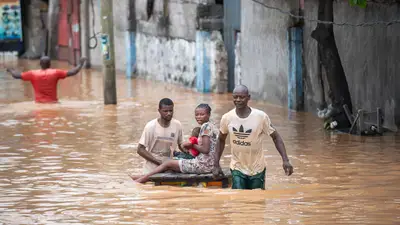
A recent study in four African countries has found that floods lead to mental health issues in about a quarter of people who experience them. The research, conducted in Burkina Faso, Kenya, Mozambique, and South Africa, aimed to investigate the link between flooding and mental wellbeing. The study's findings highlight the significant impact of floods on mental health, particularly in communities with limited resources and social support. According to the study's lead researcher, Ahri epidemiologist Collins Iwuji, the results broaden the evidence on flooding and mental health across these regions.
The study included 5,336 participants, with a sample of between 1,000 and 1,600 in each country. The sample was diverse, spanning urban and rural areas, and included a range of household sizes, employment, and education levels. This mix of socioeconomic conditions provided a comprehensive understanding of the impact of floods on mental health. The study found that signs of mental health problems were more common among people who had lived through a flood than among those who had not. In the sample as a whole, one in 12 people who had been in a flood showed signs of serious anxiety, and one in eight had symptoms pointing to depression.
The study also found that one in five flood survivors' mental state looked like that of someone with post-traumatic stress disorder (PTSD). The trend held in South Africa, but the proportion of flood survivors experiencing mental health problems was more than twice as high. According to Vasco Cumbe, a psychiatry expert on the research team, the findings show that extreme weather events like floods add another layer of stress to people's lives when they live in poverty or without good social support. Cumbe notes that people's distress compounds, and in communities like those included in the study, a next storm often hits before people can fully recover from the previous one.
The study's results have significant implications for countries where public health systems are under pressure and communities have limited means to bounce back after a disaster. The research team worked in four countries across West, East, and Southern Africa to study the link between flooding and mental wellbeing. Iwuji explains that although the findings do not represent Africa as a whole, they provide valuable insights into the impact of floods on mental health. The study's results highlight the need for decision-makers to prioritize mental health support in communities affected by floods.
The study found that if people had not been exposed to a flood, 25% fewer people would have had mental health issues. In South Africa, that portion was closer to a third. The findings suggest that limiting exposure to floods can help protect people's mental health. Iwuji recommends that people be warned about the chance of a flood early enough, so they can prepare or choose to move out of the area during that time. Simple maintenance, such as keeping drains clear, can also help reduce the impact of floods.
The study's results also highlight the need to address the root causes of climate change. Warm air holds more moisture than cool air, which means that as the Earth's air temperature continues to rise, storms and rainfall could become even heavier. The Paris Agreement, a deal reached by nearly 200 countries in 2015 to fight climate change, aims to limit global warming to 2°C above pre-industrial levels. Hitting the carbon emission targets agreed to under the Paris Agreement is critical to mitigating the impact of climate change on mental health.
The study's findings will be formally on the agenda for the first time at COP31 in Turkey in November. The yearly United Nations meeting brings together countries from around the world to discuss and agree on ways to slow down climate change and protect people from its effects. As the frequency and intensity of extreme weather events continue to rise, it is essential that decision-makers prioritize mental health support and take action to address the root causes of climate change.
Key points
- Floods lead to mental health issues in 25% of people who experience them.
- Study finds PTSD symptoms are common among flood survivors, with levels increasing by different amounts in each country.
- Limiting exposure to floods and addressing the root causes of climate change can help protect people's mental health.