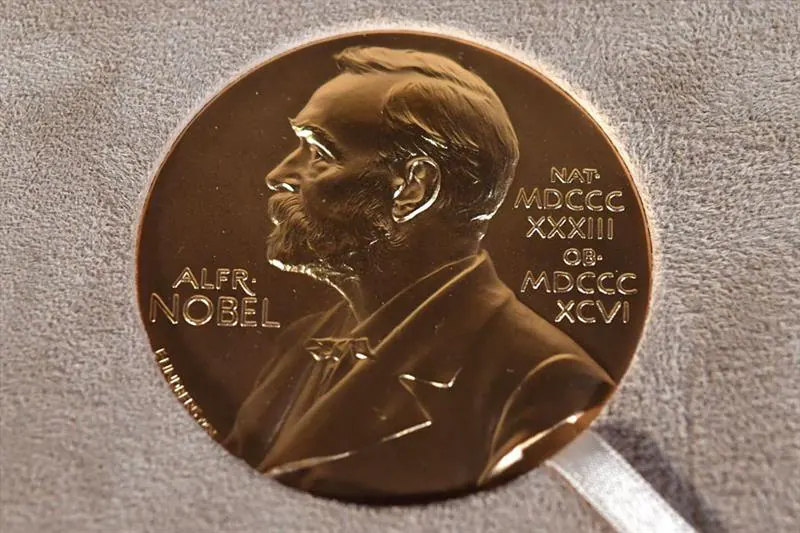
The Nobel Prizes are awarded annually to recognize outstanding contributions in the fields of medicine, physics, chemistry, peace, and literature. The prizes are awarded between October 5 and 12 in Stockholm and Oslo, with the medicine prize typically being announced first on a Monday at 11:30 am local time. The prizes were established by the will of Alfred Nobel, a Swedish inventor and chemist who died in 1896. He specified that the prizes should be awarded to those who have "conferred the greatest benefit on mankind."
Since 1901, five Nobel Peace Prize winners have been in detention when they received the award. In 1936, German journalist and pacifist Carl Von Ossietzky was in a Nazi concentration camp when he was awarded the prize. In 1991, Burmese opposition leader Aung San Suu Kyi was under house arrest and declined to attend the award ceremony in Oslo. In 2010, Chinese dissident Liu Xiaobo was in prison when he was awarded the prize, and his chair was left empty at the ceremony. In 2022, Belarusian human rights defender Ales Bialiatski was in prison when he was awarded the prize, and his wife represented him at the ceremony.
The Nobel Prizes have been awarded to people of all ages. In 2014, Pakistani activist Malala Yousafzaï became the youngest Nobel laureate at the age of 17. Australian physicist Lawrence Bragg was just 25 years old when he was awarded the Nobel Prize in Physics in 1915, along with his father. Iraqi activist Nadia Murad was also 25 years old when she was awarded the Nobel Peace Prize in 2018. On the other hand, American chemist John B. Goodenough was 97 years old when he was awarded the Nobel Prize in Chemistry in 2019.
The Nobel Prizes are not awarded posthumously, except in cases where the laureate dies after the announcement of their award. This rule was established in 1974, and prior to that, only two people had been awarded the prize posthumously. The prizes are awarded in the fields of medicine, physics, chemistry, peace, and literature, and are considered among the most prestigious awards in their respective fields.
Alfred Nobel, the founder of the Nobel Prizes, was a poet and playwright in addition to being a chemist and inventor. He wrote poetry and plays in Swedish and English, and even attempted to write a tragedy called "Nemesis" in the year of his death. The play was considered scandalous and most of the copies were burned after his death, except for three.
Women have been underrepresented among Nobel laureates, making up less than 11% of all winners since 1901. However, the proportion of female laureates has increased in recent years. Marie Curie was the first woman to be awarded a Nobel Prize, in 1903, and she remains the only person to have been awarded two Nobel Prizes in different fields.
The Nobel Prizes continue to be awarded annually, with the selection process involving nominations from around the world. The prizes are seen as a way to recognize and honor outstanding contributions to humanity, and are considered among the highest honors in their respective fields. The prizes will be awarded again this year, and the world will be watching to see who will be recognized for their achievements.
Key points
- The Nobel Prizes are awarded annually to recognize outstanding contributions in the fields of medicine, physics, chemistry, peace, and literature.
- Women have been underrepresented among Nobel laureates, making up less than 11% of all winners since 1901.
- The Nobel Prizes are not awarded posthumously, except in cases where the laureate dies after the announcement of their award.