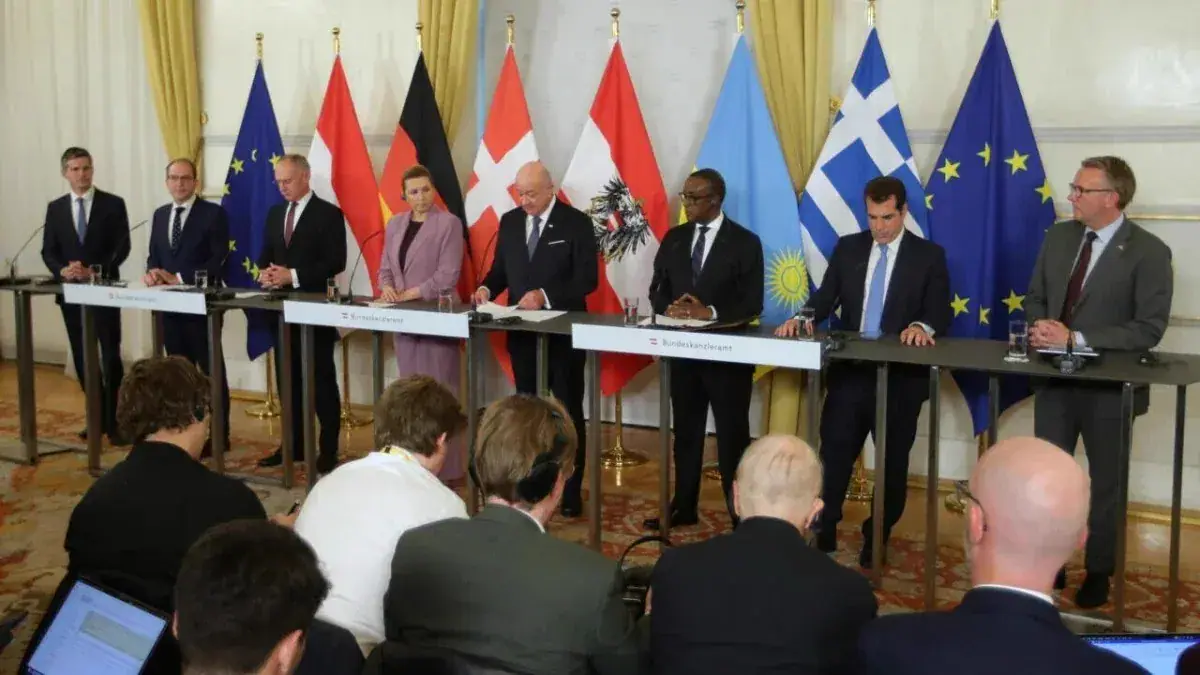
Five European countries have announced plans to relocate asylum seekers to Rwanda as part of a new migration policy. Denmark, Austria, Germany, Netherlands, and Greece revealed the plan in Vienna, Austria, at a meeting of senior politicians. The plan aims to establish a new system for managing migration, with Rwanda expected to host the first group of asylum seekers next year.
The plan is part of a pilot project to assess a broader overhaul of the European Union's migration policy. The project involves establishing centers in non-EU countries to hold and return asylum seekers whose applications have been rejected. This allows EU member states to send asylum seekers to these centers, even if they have no connection to the country.
Danish Prime Minister Mette Frederiksen said the move is crucial for building a new migration system that protects the EU's cohesion while addressing citizens' concerns. She emphasized that European countries need to regain control of their borders. However, despite strong political rhetoric on migration control, the number of people entering the EU irregularly has decreased this year.
According to a recent analysis by the Mixed Migration Centre, a non-governmental organization, the number of people entering the EU irregularly has dropped by nearly 37% in the first seven months of 2026 compared to the same period in 2025. The plan has been long-awaited, following the EU's push to establish centers in non-EU countries to hold and return rejected asylum seekers.
Rwanda, Uganda, and Uzbekistan were considered potential partners for the plan. Rwanda is expected to be the first country to sign a cooperation agreement with Denmark, with the deal potentially being finalized next week. However, experts and critics have raised concerns that many important questions about the plan remain unanswered.
Davide Colombi, a researcher at the Centre for European Policy Studies, said many essential details are still unclear, including who will manage the centers, the overall budget, and the type of legal agreement to be used. Colombi also questioned the scope and responsibilities of the independent monitoring authority and the legal rights and recourse available to those transferred.
The announcement was described as an "agreement in principle," indicating that a formal legal agreement outlining all aspects of the plan still needs to be negotiated. As a result, despite the announcement, concerns remain about the management of the centers, their funding, the rights of those transferred, and the legal responsibilities of the countries involved.
Key points
- The plan aims to establish a new system for managing migration, with Rwanda expected to host the first group of asylum seekers next year.