A Finnish innovation expert has shared insights with a Tanzanian delegation on how to unlock the country's blue economy potential. Janne Saarikko from the Natural Resources Institute Finland (Luke) emphasized the importance of making research respond to real market problems. He advised against developing technologies first and searching for customers later. Instead, he recommended finding someone with a big enough problem to solve before innovating. This approach was presented during a study visit under the European Union-funded Digital for Tanzania (D4T) Twinning project.
The Digital for Tanzania (D4T) Twinning project supports Tanzania's digital transformation, including private-sector and research capacity building. Finland leads the project's private-sector and research component. During the presentation on September 25, 2026, Mr. Saarikko explained Luke's "co-development" approach. This approach requires researchers to understand the problem before developing a solution. Prospective founders are asked to prepare two slides explaining the problem they want to solve and their proposed approach. They then speak to potential customers, record responses, and improve their idea based on feedback.
Tanzania can apply Finland's experience to its National Blue Economy Policy 2024 and the Fisheries and Aquaculture Blue Economy Action Plan 2025–2035. The 10-year action plan aims to increase investment, value addition, technology use, research, aquaculture productivity, and sustainable use of aquatic resources. The plan identifies technologies such as artificial intelligence, remote sensing, and marine robotics as areas for development. The World Bank reports that fishing and aquaculture contribute 1.8 percent of Mainland Tanzania's GDP and 4.8 percent of Zanzibar's GDP.
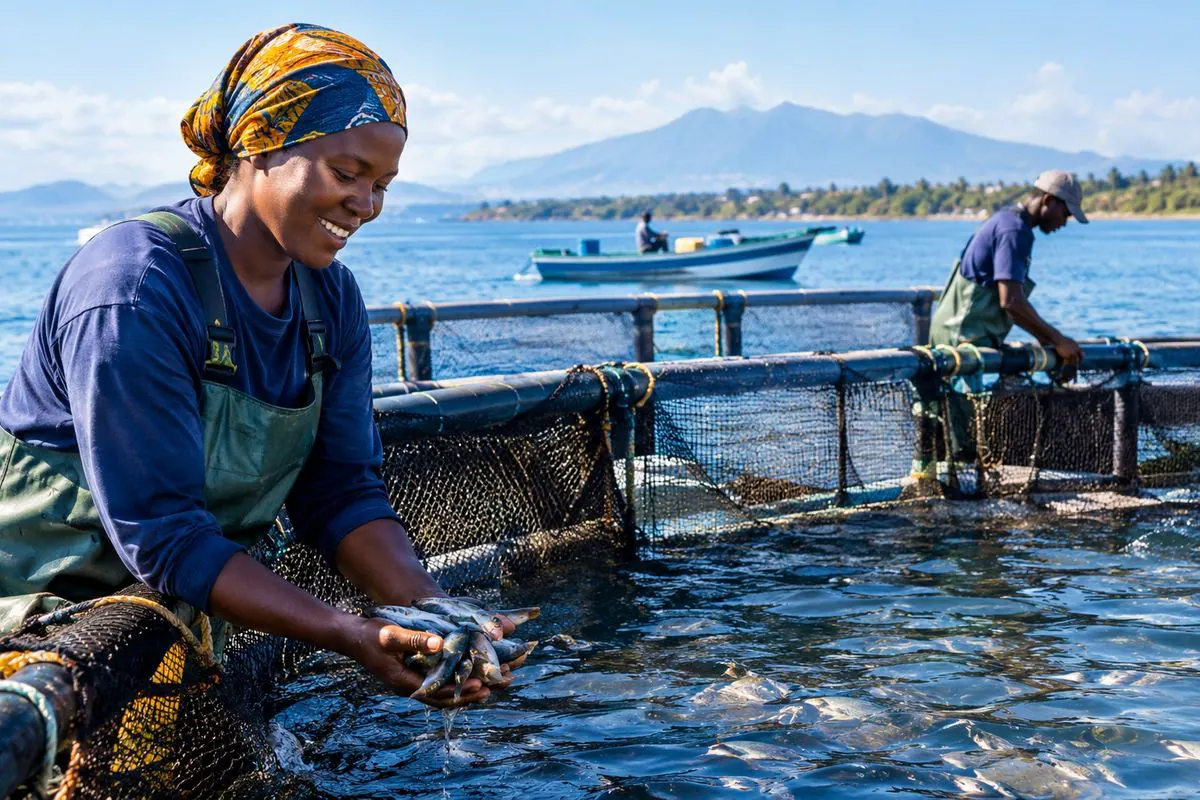
The blue economy sector provides significant economic and social benefits to Tanzania. About 430,000 people work directly in the sectors, and more than 4.5 million depend on related activities such as processing, marketing, and sales. Fish provides about 30 percent of daily animal protein consumption on the mainland and 90 percent in Zanzibar. Aquaculture is also expanding, with Tanzania producing over 138,600 tonnes of aquaculture products in 2024, including about 43,590 tonnes of finfish and nearly 94,980 tonnes of seaweed.
Finland's experience in commercializing research can be particularly relevant to Tanzania. Luke has several routes for commercializing research, including partnerships with companies, licensing patented technologies, and creating spin-off companies. Its support system includes proof-of-concept funding, intellectual-property and patent support, innovation coaching, and links to accelerators and investors. Luke has developed aquaculture innovations, such as technology for recirculating aquaculture systems and a filtration technology designed to remove compounds responsible for unpleasant flavors in farmed fish.
Successful innovation depends on the right combination of technology, market demand, capable teams, and regulation. Mr. Saarikko emphasized the importance of regulation, arguing that governments should maintain necessary safeguards while making approval processes faster and more predictable. The Tanzanian delegation noted that the Finnish experience points to a broader lesson: blue-economy transformation requires building the research, digital systems, businesses, and regulatory environment needed to convert resources into sustainable economic value.
The Head of ICT development at Tanzania's ICT Commission, Dr. Ally Simba, highlighted the importance of collaboration and knowledge sharing. The Tanzanian delegation's visit to Finland was an opportunity to learn from Finland's experience and apply it to Tanzania's blue-economy ambitions. By adopting a co-development approach and creating a supportive ecosystem for innovation, Tanzania can unlock the full potential of its blue economy and create sustainable economic value.
Key points
- Tanzania can apply Finland's experience in blue-economy innovation to its National Blue Economy Policy 2024.
- Finland's "co-development" approach involves understanding the problem before developing a solution.
- The blue economy sector provides significant economic and social benefits to Tanzania, with about 430,000 people working directly in the sectors.