The financial state of Tunisia's public transport sector has been laid bare in recent reports. The Société de transport du Sahel (STS), a key player in the industry, is facing significant challenges. According to audited accounts from 2021, reviewed in May 2026, STS has substantial negative equity, standing at -59.8 million Tunisian dinars (MDT). This situation is concerning, with the company's loss nearly doubling from 6.0 MDT in 2020 to 11.3 MDT in 2021.
A comparison with the Société régionale de transport de Kairouan (SORETRAK) highlights the stark contrast in their financial health. SORETRAK's 2025 accounts, audited in May 2026, show a positive net result of 4.2 MDT, with equity increasing to 9.3 MDT. This is largely due to investment subsidies and profits. In contrast, STS's financial struggles are attributed to decreased operating subsidies and increased expenses. The company's operating subsidy decreased by 5.92 MDT to 50.6 MDT, while its expenses rose by 2.76 MDT, primarily due to a 2.33 MDT increase in fuel costs.
The financial difficulties faced by STS are further exacerbated by its significant workforce costs. The company's personnel expenses reached 48.8 MDT, nearly equivalent to its operating subsidy of 50.6 MDT. This represents 192% of its revenue, with each dinar earned generating 1.92 dinars in salary costs. In comparison, SORETRAK's personnel expenses account for 1.40 dinars per dinar earned. The issue is compounded by substantial debts owed to STS by various government ministries, including 13.2 MDT by the Ministry of Interior and 2.2 MDT by the Ministry of Defense.
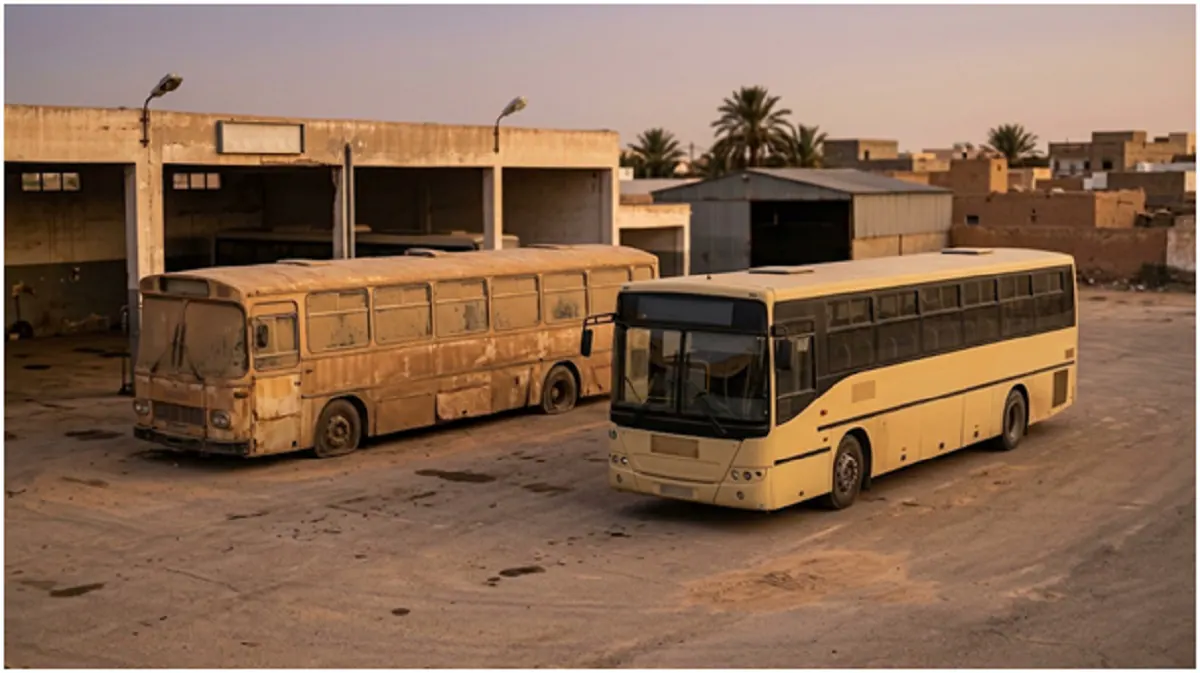
The company's aging fleet and substantial bank debt also pose significant challenges. STS's transport equipment is 90% depreciated, with 20.5 MDT worth of buses out of service. In contrast, SORETRAK has invested in renewing its fleet, acquiring 9.6 MDT worth of new transport equipment in 2025. STS's bank debt, incurred for purchasing 158 buses, stands at 21.9 MDT, with an additional 3.3 MDT in future interest payments.
The cash flow situation at STS appears healthier than expected, but this is largely due to increased current debts. The company's accounts also reveal issues with tax and social security payments. STS has retained 18.1 MDT in source deductions from employees and suppliers, while owing 15.3 MDT in current social security contributions. The company also faces potential tax penalties, having provisioned 3.1 MDT for likely fines.
Both STS and SORETRAK share the same commissioner, Lotfi Hammi, who has raised concerns about the accuracy of their financial records. In both cases, the inventory of immobilizations was not verified against the accounting records, and no shareholder register exists. Additional concerns were raised about SORETRAK, including unregistered land, a stalled workshop project, and unaccounted overtime.
The financial struggles of STS and the public transport sector in Tunisia raise concerns about the sector's sustainability. Key issues include the need for improved financial management, increased investment in infrastructure and equipment, and addressing the substantial debts owed by government ministries. The sector's challenges have significant implications for the country's transportation network and the citizens it serves.
Key points
- Société de transport du Sahel (STS) faces severe financial difficulties, with -59.8 MDT in negative equity and a nearly doubled loss from 2020 to 2021.
- The financial health of SORETRAK contrasts with STS, with a positive net result of 4.2 MDT and increased equity.
- The public transport sector in Tunisia faces significant challenges, including aging infrastructure, substantial workforce costs, and debts owed by government ministries.